How to carb load to maximize your glycogen stores
Most carb-loading guides are based on generic advice. Here’s how to calculate your exact carb-loading numbers to store up to 47% more glycogen, and how to make it easy to execute.
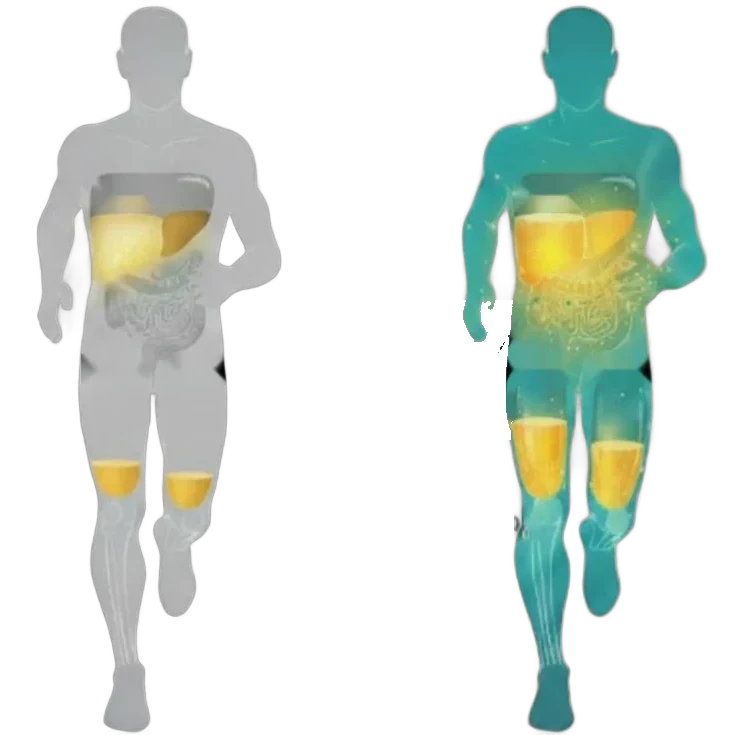
What a carb load does
More glycogen at the start, more power in the last hour
Carb loading means eating more carbohydrate than usual for a few days so your muscles store more glycogen than they normally hold.
In a 1995 study, 8 cyclists each completed 2 rides of 3 hours, one after raising their carbohydrate intake by about 72% and one on their normal diet.
Muscle biopsies showed the athletes who carb loaded started with 47% more muscle glycogen, and the riders covered more distance and held more power over the final 60 minutes.
That means the extra glycogen shows up in the final hour of your race, when your pace would otherwise start to fade.
The same pattern turns up in runners. A study of 257 runners at the 2009 London Marathon compared what they ate the day before with how they ran.
Runners who ate more than 7 grams of carbohydrate per kilogram of body weight (3.2 g per lb) ran faster, and slowed down less over the back half, than the runners who ate less than 7 grams.
More fuel in your muscles at the start
- Normal diet: 104 mmol/kg
- Carb loaded: 153 mmol/kg
8 cyclists, 3-day load, muscle biopsies (Rauch 1995)
More power over the final hour of a 3-hour ride
- Normal diet: 219 W
- Carb loaded: 233 W, and 1.3 km (0.8 mi) farther
Same 8 cyclists, final 60 minutes (Rauch 1995)
London Marathon runners ate enough carbs the day before
- 227 ate less than 7 g/kg
- 30 ate over 7 g/kg (3.2 g/lb): faster finish, less slowing
257 runners, 2009 London Marathon, self-reported diet (Atkinson 2011)
Do you need one?
Your finish time decides
You store enough glycogen to cover about 90 minutes of running.
If your race takes less than that, you finish with glycogen to spare, so loading adds nothing. Eat normally, keep carbohydrate up the day before, and get race morning right.
Between 90 minutes and 2 hours, one elevated day is enough. Raise carbohydrate to 6 to 8 g per kilogram of body weight (2.7 to 3.6 g per lb) for the final 24 hours and skip the multi-day version.
Past 2 hours, do a full load. This is where the studies measured the biggest gains.
Your projected finish time. Under 90 minutes, normal glycogen covers the race.
Why percentages fail
Your body weight sets the dose
Most carb-loading advice is written as a percentage: eat 70 to 75% of your calories as carbohydrate, or fill most of your plate with pasta and rice.
A percentage of a small appetite is a small number of grams. Your muscles start storing extra glycogen at about 8 g of carbohydrate per kilogram of body weight per day (3.6 g per lb).
As an example, the 75% rule for a 125 lb (57 kg) runner works out to 448 g of carbohydrate a day. That is 7.9 g/kg (3.6 g/lb), just under the 8 g/kg threshold.
That means she can follow the instructions perfectly for 3 days and never carb load at all.
The optimal load is 8 to 12 g of carbohydrate per kilogram of body weight per day (3.6 to 5.5 g per lb). For a 150 lb (68 kg) runner that is 545 to 815 g of carbohydrate a day.
The 75% rule for a 125 lb (57 kg) runner: 448 g a day, 7.9 g/kg, under the loading band.
Total calories have to go up
The load needs extra calories
Older advice said to keep your calories the same and swap fat for carbohydrate. That method has been tested, and it does not raise muscle glycogen.
In a 2001 study, women who raised carbohydrate as a share of their calories did not raise their muscle glycogen at all. When their total calories rose by 34% alongside the carbohydrate, muscle glycogen rose by about 17%.
That means you have to eat more total calories, and the extra should be carbohydrate. For a 150 lb (68 kg) runner that is roughly 700 to 1,000 calories a day above a normal race-week day.
Cut fat back a little, because it fills you up and you need room for 600 g of carbohydrate. Keep protein at about 1.5 g per kilogram of body weight (0.7 g per lb).
Change in muscle glycogen in the 2001 study of women. Swapping alone added nothing.
Skip the depletion run
Rest plus the right dose fills your muscles in 24 hours
The old protocol had you do a hard run and cut carbohydrate a few days out, on the theory that emptying your muscles first makes them store more later.
Researchers tested this directly in 2002. 8 endurance-trained men did no depleting exercise at all, stayed inactive, and ate 10 g of carbohydrate per kilogram of body weight (4.5 g per lb) each day. Muscle glycogen went from 95 to 180 mmol per kg of wet muscle in 24 hours, close to double, and 2 further days of loading added nothing.
That means you do not need the depletion run. It adds fatigue in race week and no extra glycogen.
Muscle glycogen, mmol per kg of wet muscle, with no depleting run at all.
The 3 ways to carb load
Your taper picks the protocol
Classic 3-week taper
8 to 10 g/kg (3.6 to 4.5 g/lb) across the final 3 days if you are a recreational runner.
10 to 12 g/kg (4.5 to 5.5 g/lb) across the final 2 days if you are well trained and used to handling volume.
150 lb (68 kg): 545 to 680 g a dayShort 1 to 2 week taper
Hold 10 g/kg (4.5 g/lb) for the 3 days before the race.
150 lb (68 kg): 680 g a dayNo taper
10 to 12 g/kg (4.5 to 5.5 g/lb) the day before, on a rest day, with no depleting run.
150 lb (68 kg): 680 to 815 gRace morning
Race morning is where most runners get it wrong
Most carb-loading guides stop at the day before the race and say nothing about breakfast.
Your muscles keep their glycogen overnight, but your liver uses some of its glycogen while you sleep. Breakfast refills it.
Starting 3 hours before the gun, take 1 g of carbohydrate per kilogram of body weight (0.45 g per lb) for every hour between your meal and the start. For a 150 lb (68 kg) runner eating 3 hours out, that is about 205 g of carbohydrate at breakfast.
A bagel with jam, a banana, a large glass of juice and a sports drink gets you close. Nothing on that plate should be new.
Breakfast for a 150 lb (68 kg) runner, by hours before the start.
Expect the scale to go up
The extra weight is glycogen and water
Your body stores about 3 g of water with every gram of glycogen, so a full load adds 2 to 4 lb (1 to 2 kg). That weight means the load worked. You lose it again over the first few miles as you burn the glycogen off.
Go low on fiber for the final 24 to 48 hours, make lunch the day before your biggest meal, and use liquid carbohydrate (juice, sports drink) when you cannot eat any more solid food.
Your numbers
Your carb load, in grams per day
Enter your weight, your goal time, your race date and your taper. The calculator checks whether your race needs a load, picks the protocol, and gives you the grams of carbohydrate for each dated day plus your race-morning breakfast.
Enter your weight and goal time. You get:
- Whether your race needs a loadfull load
- Grams of carbohydrate for each dated day545 to 680 g
- Race-morning breakfast205 g at breakfast
- Protein to hold each day100 g
In the app
How CarbRate does this for you
It checks whether your race needs a load, before it prescribes anything
CarbRate uses the weight and goal time from your fueling plan. If your projected finish is under 90 minutes, it tells you to skip the load.
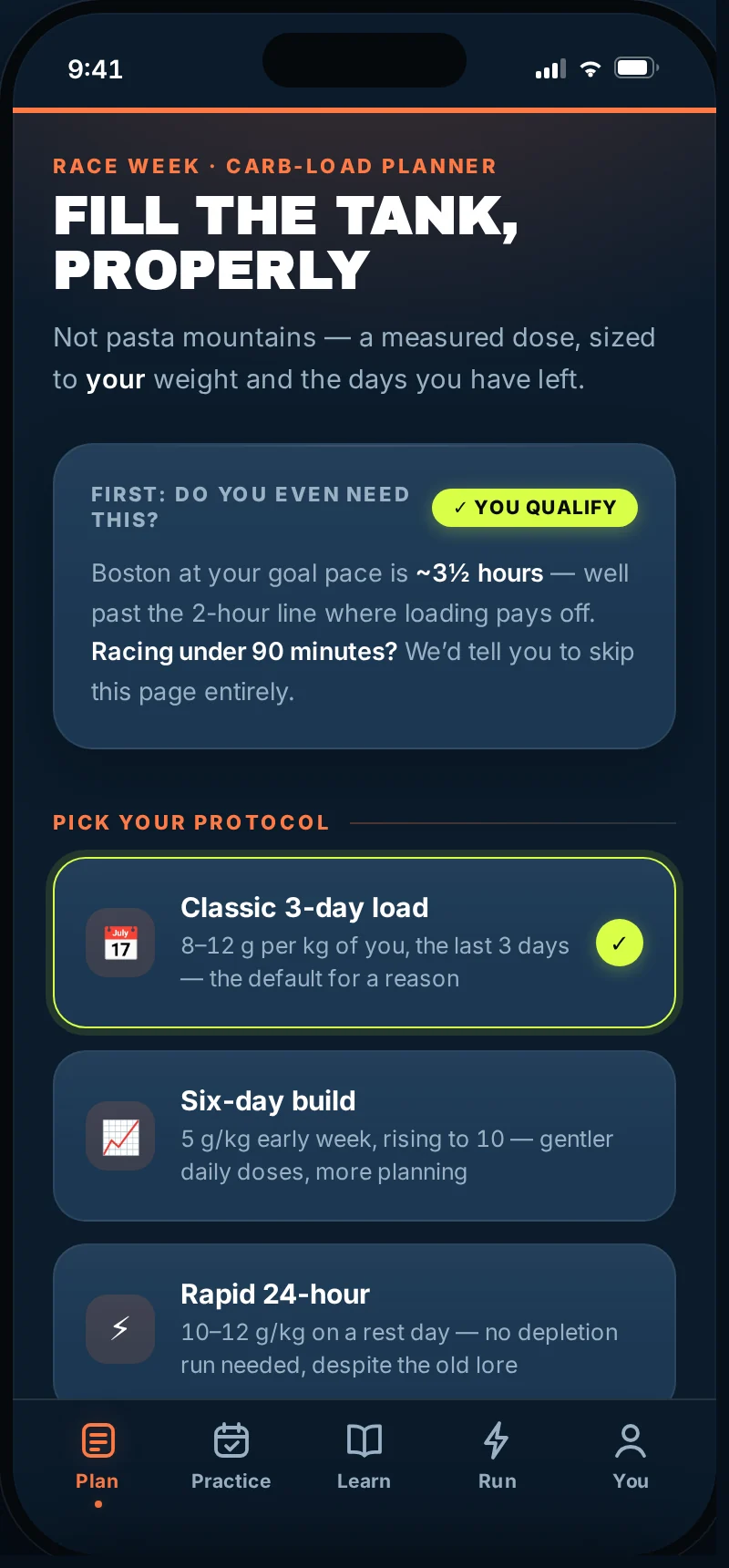
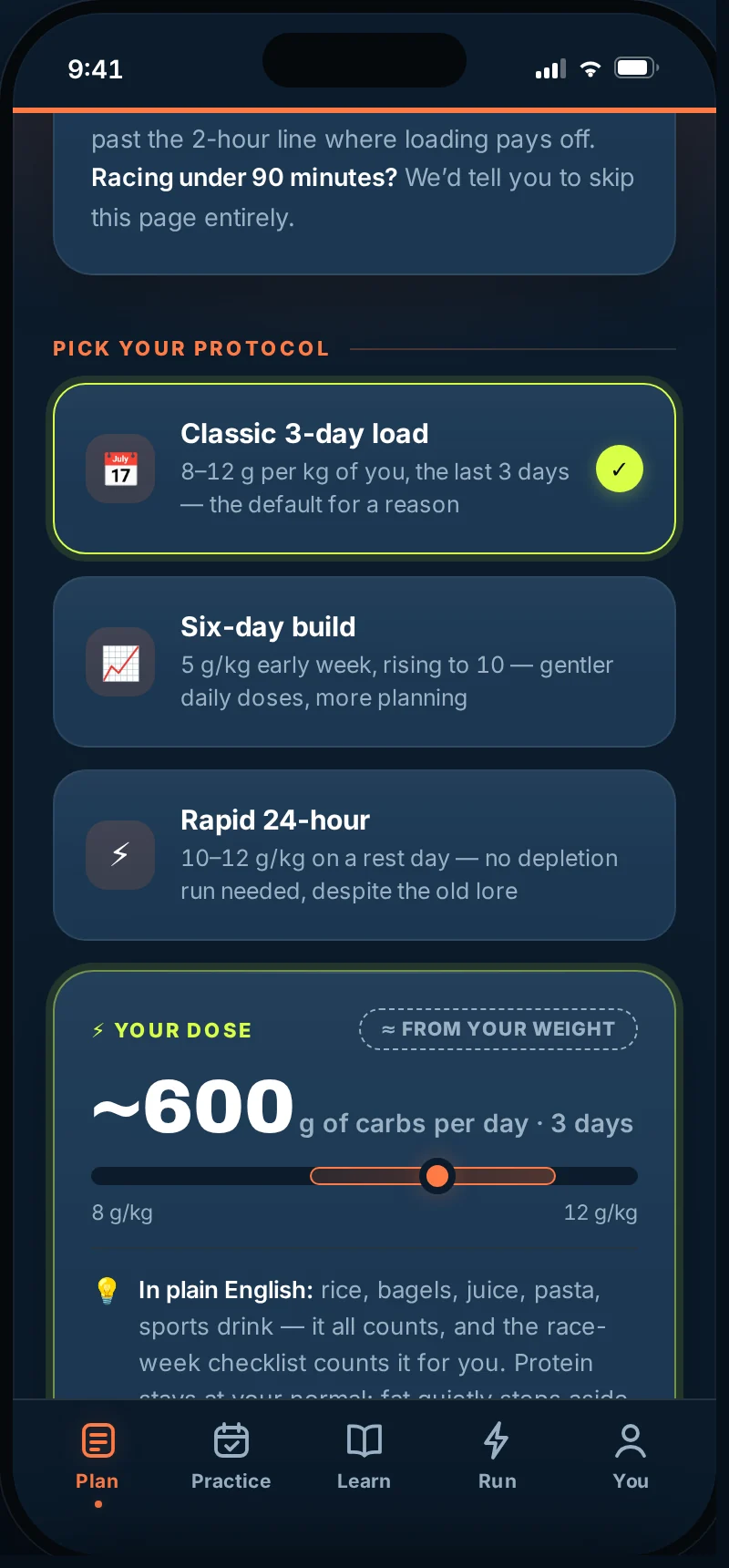
It applies the dose for your taper
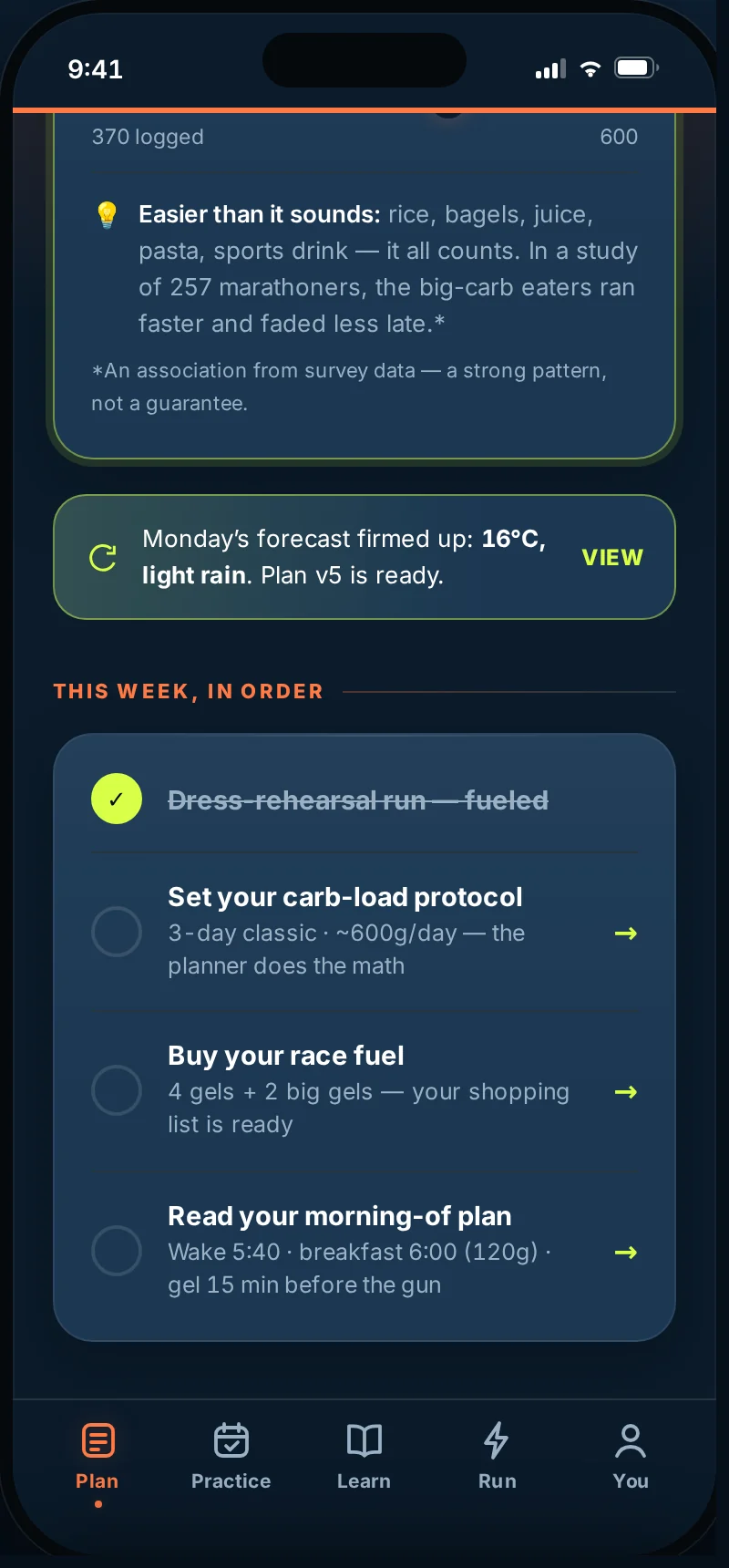
Pick the taper you are running and CarbRate gives you one carbohydrate target for each loading day, with protein held at 1.5 g/kg (0.7 g/lb).
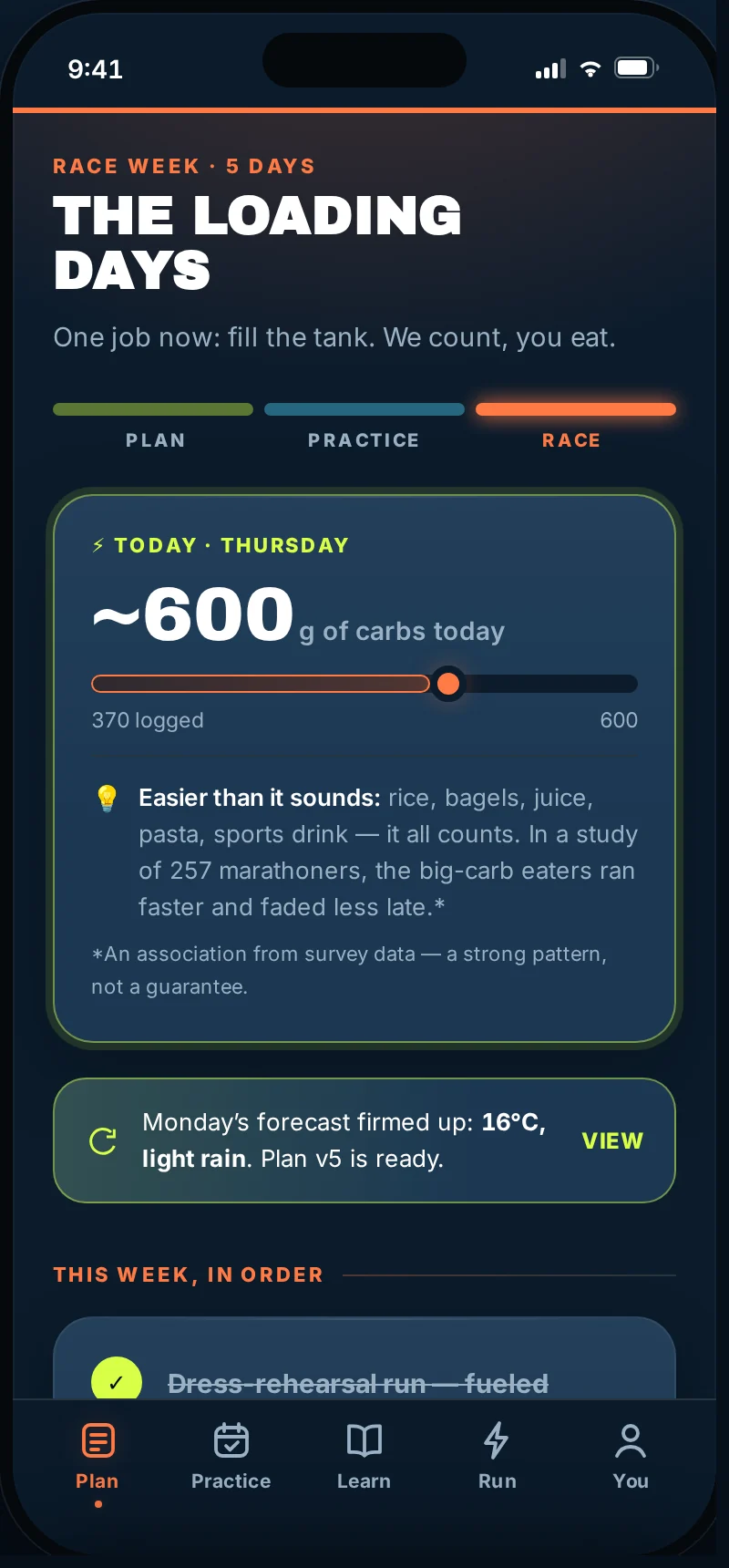
It puts every loading day on a dated checklist
Each loading day is listed against your race date with its carbohydrate target, and you can turn on a reminder each morning.
It gives you breakfast, then counts down the race
On race morning CarbRate gives you the grams for breakfast from the hours you set. During the race it counts down to every gel and sip and reads each one out loud.
Start to finish
From your first long run to the finish line
A fueling plan from your numbers
Weight, goal time, your actual course, the products you like and race-day weather.
How it works →A week-by-week practice schedule
Fueling practice on your long runs, with a carb target that rises toward your race-day number.
How it works →Your carb load, day by day
The dose for your taper on a dated checklist, and the grams for race-morning breakfast.
Your numbers above ↑Live guidance for every feed
CarbRate counts down to every gel and sip, tells you exactly what to take and where, and reads it out loud over your music.
How it works →Build your free fueling plan
The carb-load planner opens from your plan dashboard once your plan is built. The free plan is a complete race-day fueling plan and it does not expire.