A fueling plan built from your own numbers
Tired of fueling advice that hands you the same gel every 30 minutes it hands a runner 40 pounds lighter and an hour faster?
CarbRate builds your plan from your weight, your goal time, your measured sweat rate, what your stomach handles today, and the weather you will be running in.
Twelve questions, about four minutes, and every one of them has an answer for people who are not sure.
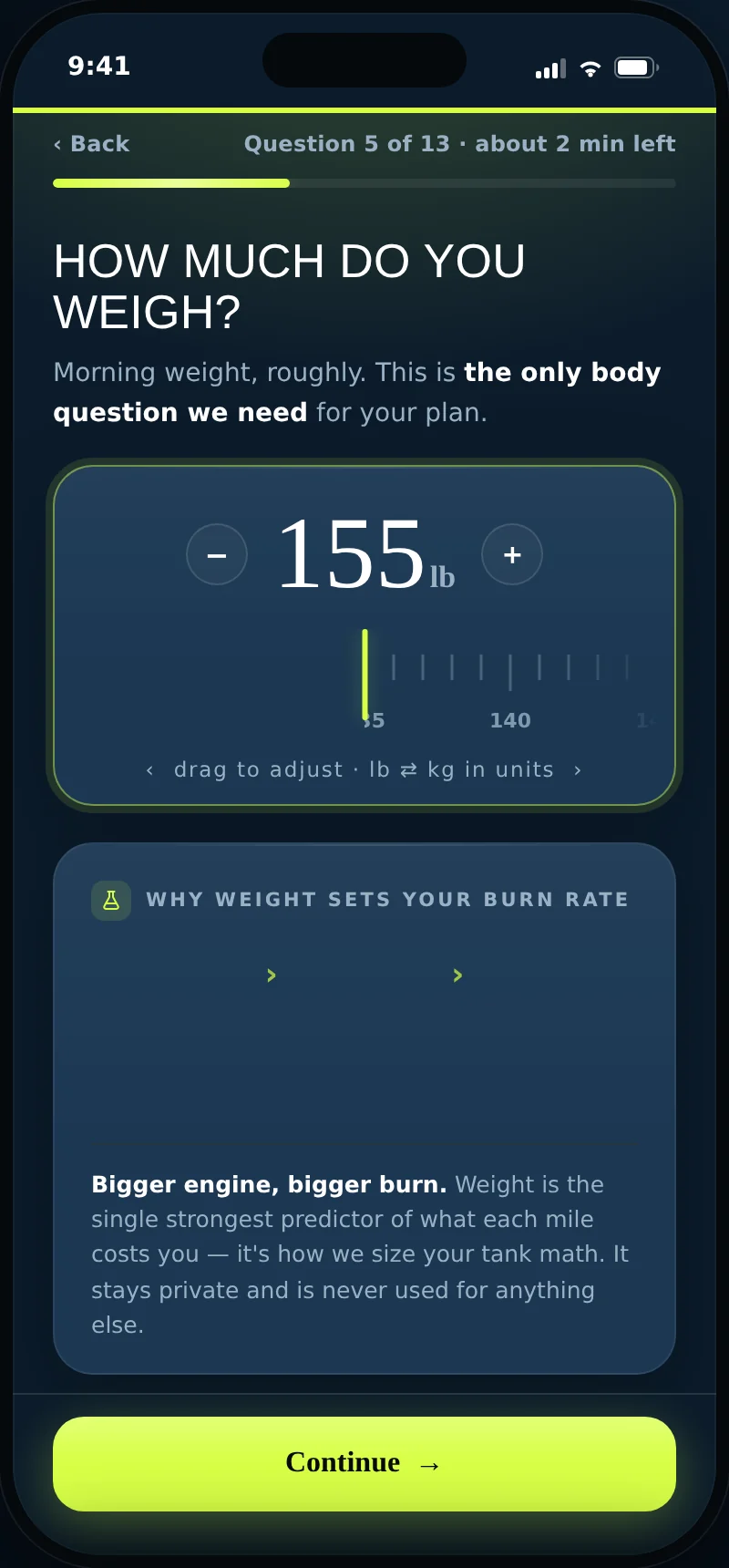
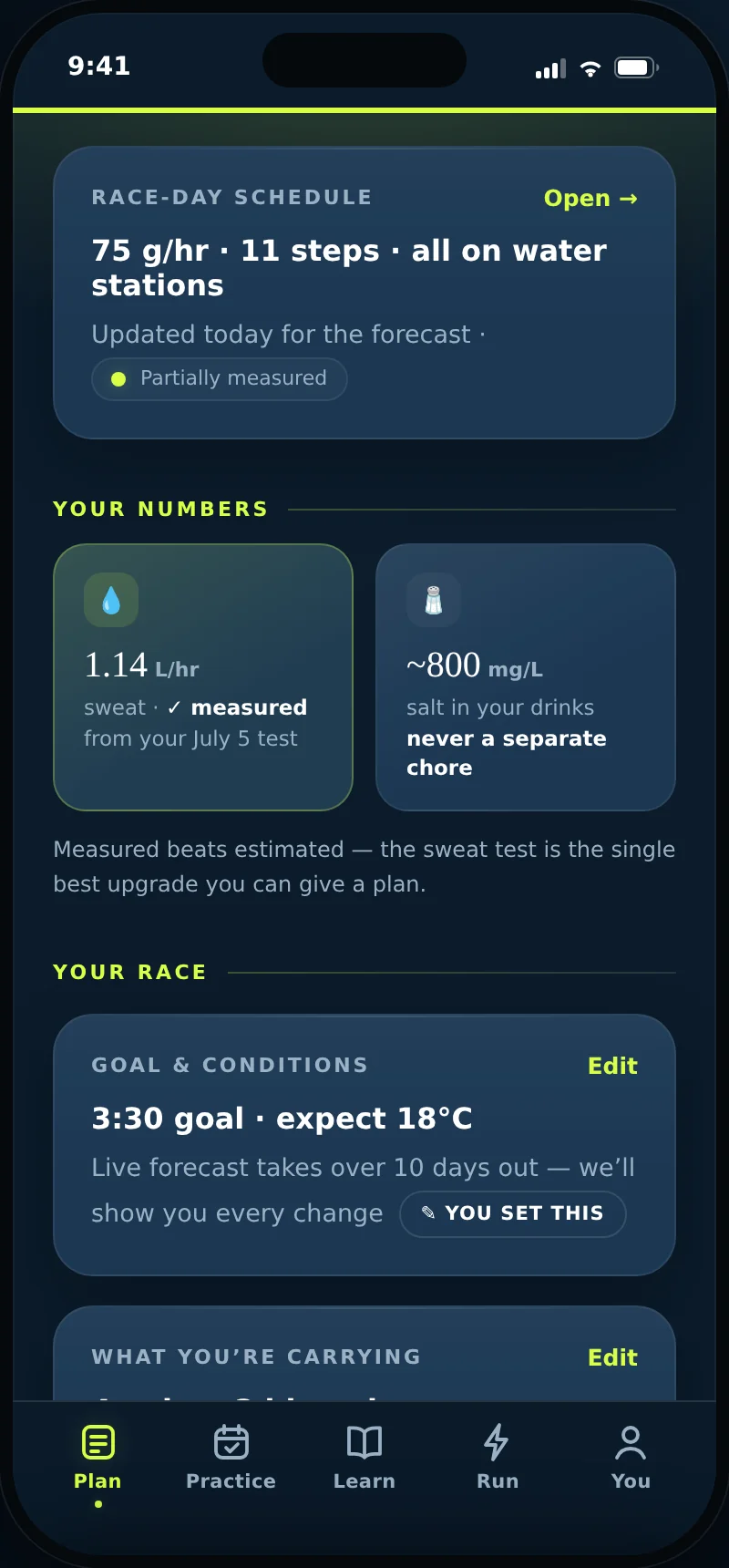
Why generic fueling numbers leave you bloated or empty, even when you follow them exactly
The advice everybody gets is a range. Sixty to ninety grams of carbohydrate an hour. Drink to thirst. Take some salt.
A range is honest for a population and useless for one runner.
Sixty grams an hour is barely a third of what a fast marathoner burns, and it is already at the ceiling of a stomach that has never practiced.
Fluid is worse. somewhere between 0.5 and 2.0 litres an hour, a fourfold spread, and the article handing you a drink-500ml-an-hour rule has no idea where in that spread you sit.
So you follow the number exactly, and you are either sloshing at mile 18 or running on empty at mile 22.
It was never your execution that failed. The number was never yours to begin with.
Luckily, every one of those numbers can be worked out from things you already know about yourself. CarbRate asks for them, one question at a time.
Four numbers decide your plan, and all four are yours
How much carbohydrate you need comes from how long you will be out there. sets a single-source ceiling near 60 grams an hour and takes it to about 90 for the longest efforts.
What your stomach handles today sets the ceiling on top of that, and it is usually your stomach rather than your legs that decides.
How much you drink comes from your sweat rate, which is driven by how hard you are working and the conditions you are in, then modified by your size.
And the sodium in your plan is a concentration of what you drink, never a separate hourly dose to swallow.
Those are real numbers out of the CarbRate engine, same race, same conditions, different runners.
The same 26.2 miles asks one runner for 199 grams of carbohydrate and another for 393, and asks one for barely half the fluid of the other.
Working that out yourself means a heat-balance calculation, a glycogen model, and a set of scales.
That is why CarbRate computes all four from twelve questions, and shows you where every single number came from.
CarbRate works out what your race takes from your own weight and goal time
Two runners on the same start line are running two different races.
Weight is the strongest single predictor of what each mile takes out of you, and your goal time decides how fast that bill comes due.
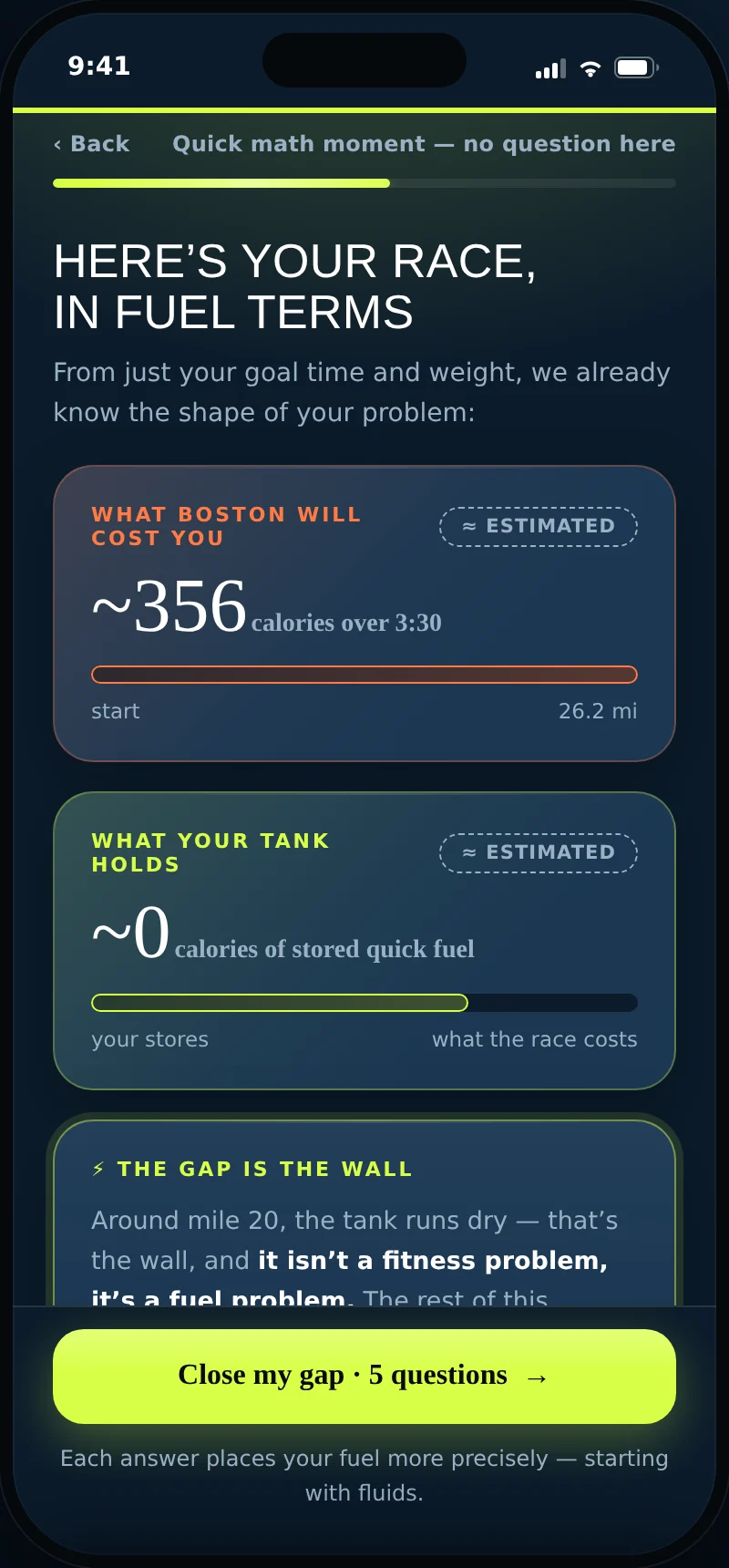
CarbRate puts the two together before it asks you anything else, and shows you the gap between what your race takes and what your body can store.
That gap is the wall, and it is arithmetic rather than a fitness problem.
Every question after that one exists to close it.
CarbRate tells you which of your numbers are measured and which are guesses
Every number in your plan carries a label. You set this, or estimated.
That sounds like a small thing. It is the difference between a plan you can trust and one that only looks precise.
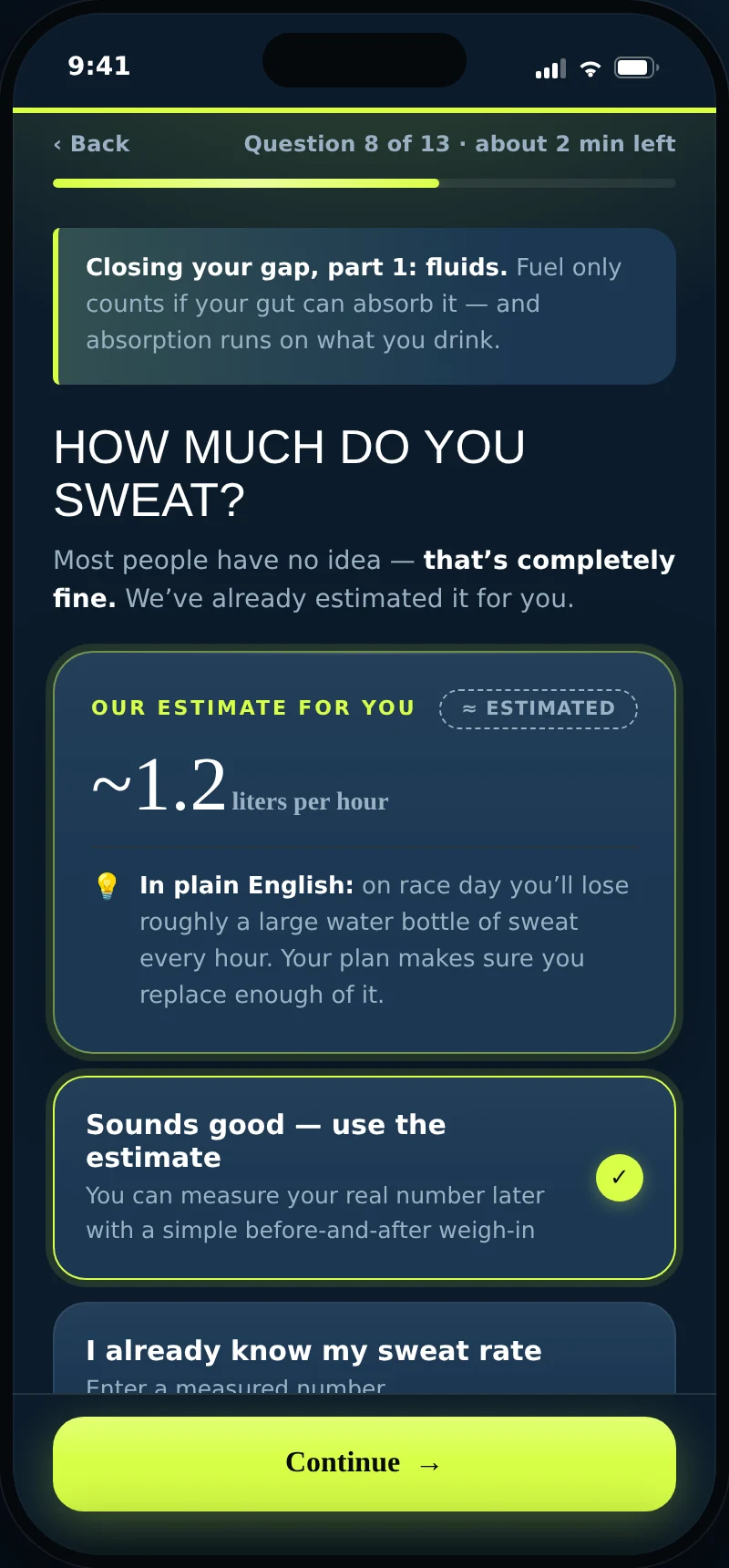
CarbRate will not guess your sweat rate from proxy questions about how much you sweat compared to your friends, because a guess dressed up as personalization is worse than an honest estimate.
So it starts you with a modelled number and shows the band around it, which is wide at first and says so.
Then it tells you exactly how to make that band smaller.
CarbRate turns your sweat rate from an estimate into a measured number in one run
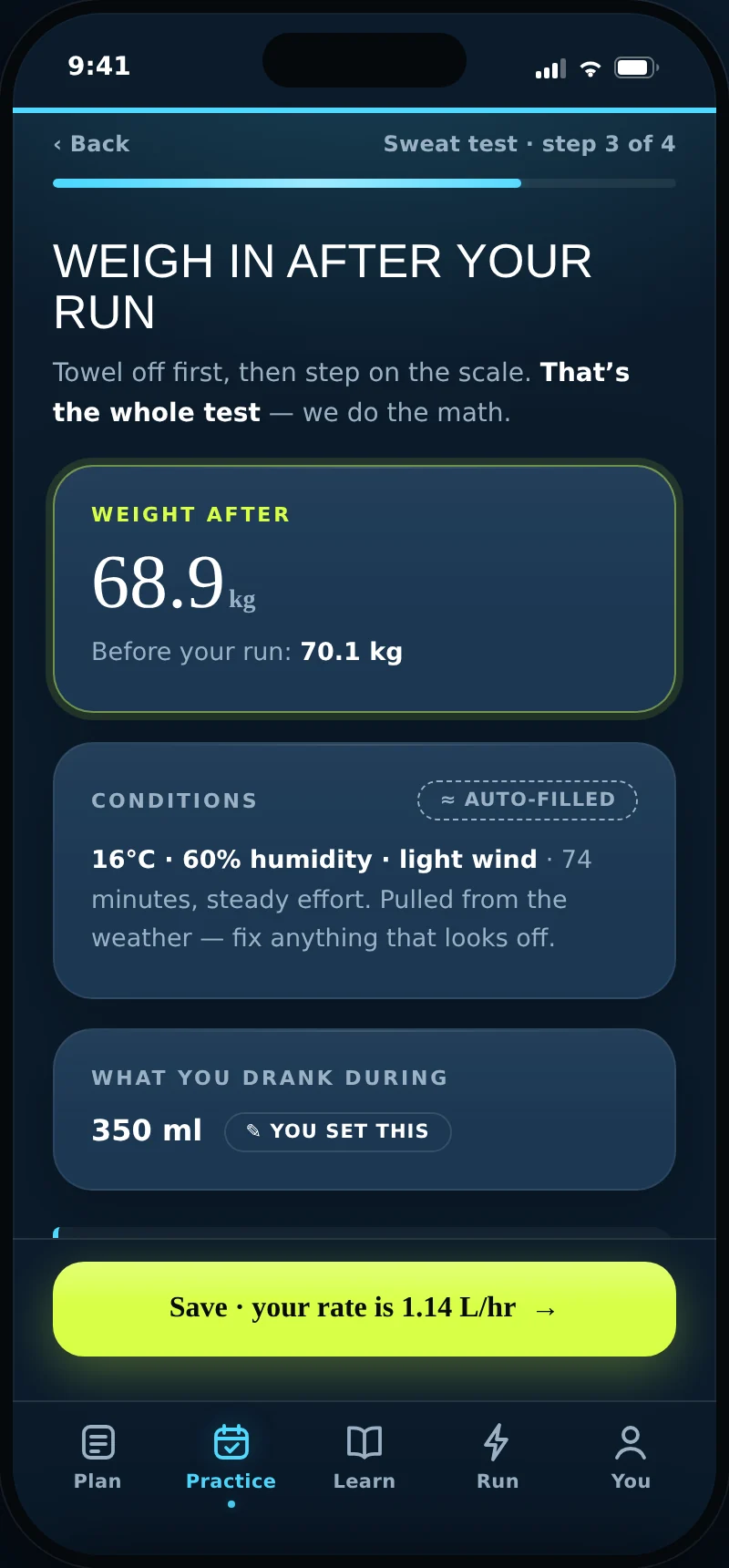
Weigh yourself before a run, run at least 45 minutes, towel off and weigh yourself again, and tell CarbRate what you drank.
That is the whole test. CarbRate does the arithmetic and writes the result into your plan.
The band around your sweat rate starts at roughly ±45% and tightens toward ±12% as you log tests, and your fluid and sodium tighten with it.
It also learns a personal factor from every test rather than replacing the model outright, so one bad weigh-in moves your plan by about 13%, not by 200%.
A two-minute weigh-in around a run you were doing anyway is the single biggest upgrade you can give a fueling plan.
CarbRate shows you what changes before you commit to it
A plan you cannot interrogate is a plan you will not trust in the last hour of a race.
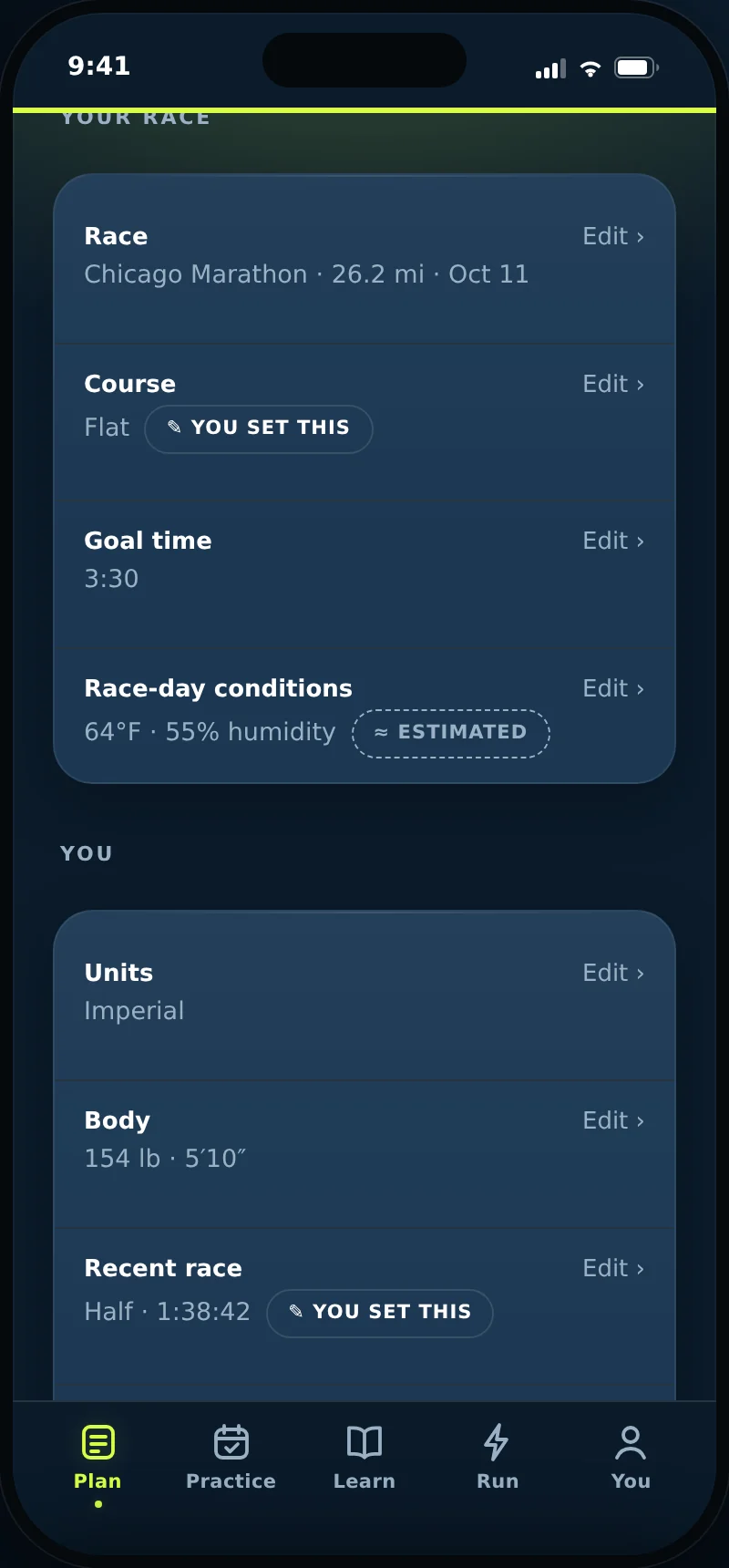
So every driver in your plan is a card you can open. Move your goal time from 3:30 to 3:25 and CarbRate shows you the answer before you save it.
Carbs 75 to 78 grams an hour. Projected finish 3:34 to 3:29.
Only the rows that actually moved get printed, so the absence of a row is information too.
Nothing about your plan is a black box, and no change happens to it behind your back.
Do not know your numbers? Used a calculator before?
Your training was never generic. Your fueling should not be either
You picked your shoes for your feet and your paces off your own race times.
Then race morning arrives and you fuel off a number written for the average of everybody.
- Fueling plan built on your exact course
- Personalized to your sweat rate, weight, and goal
- Adjusts when the race-day forecast moves
- Week-by-week gut-training practice schedule
- One prescribed change after every rough run
- The dress-rehearsal run, scheduled early
- Live guidance through every gel and drink
- All 163 gels, chews, and mixes built in
See how CarbRate handles the rest of your race
A page for each one: