A fueling plan drawn on your actual course
Tired of a fueling plan that tells you to take a gel at 40 minutes, when 40 minutes puts you halfway up a hill with no water in sight?
CarbRate places every gel and every drink on the real course you are running, using its actual elevation profile and the aid stations the race publishes.
So each feed lands somewhere you can actually swallow it: on a runnable grade, with water in your hand.
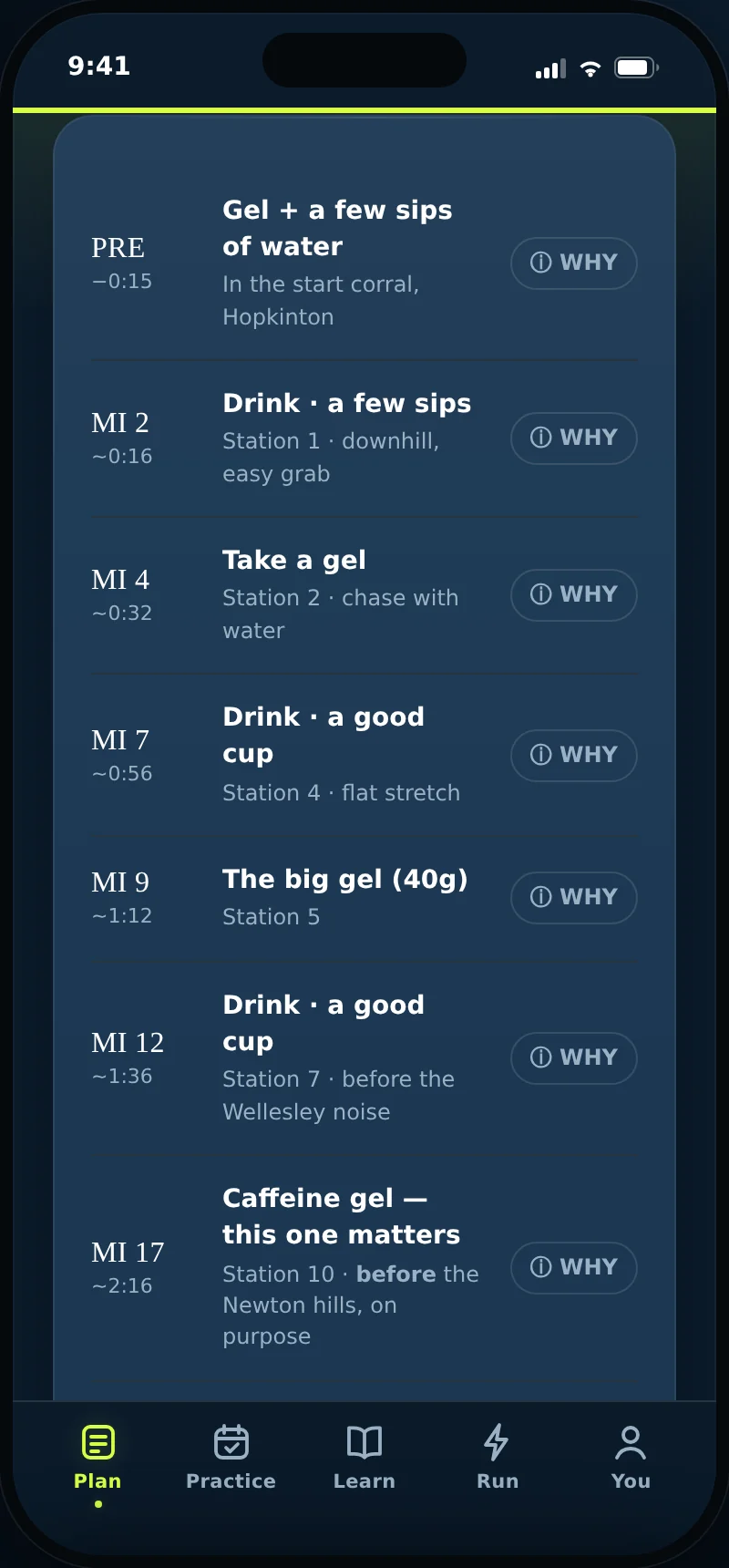
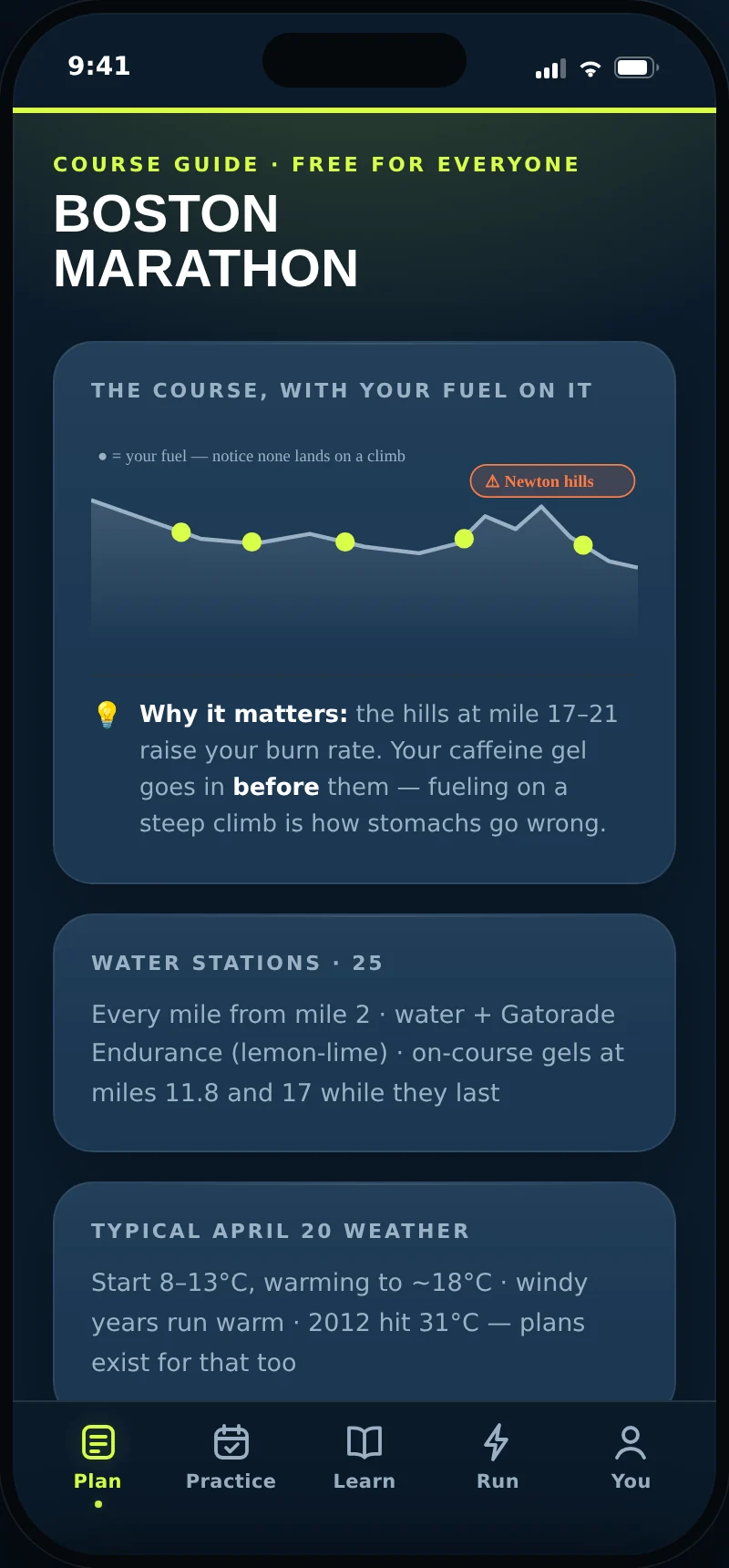
Why a gel at the wrong mile leaves you gagging on a climb, even when you took it exactly on schedule
Almost every fueling plan you will ever be handed is written in minutes. A gel every 30 minutes, a few sips every 15.
Minutes do not know where you are.
Thirty minutes into your race might put you at the bottom of a climb, halfway down a technical descent, or a mile past the last water table.
Taking a gel on a steep climb is the worst possible moment to ask anything of your stomach. Running hard already by as much as 80%, and a climb at race effort cuts it further.
Taking one without water is nearly as bad. A gel is concentrated carbohydrate, and it needs fluid to move out of your stomach and get absorbed.
That is how a plan you followed to the letter still ends with a gel sitting in your stomach at mile 20.
And the miles where your fueling matters most are the ones a generic plan knows least about: the long climbs late in the race, where you are burning hardest and the water is furthest apart.
Luckily, your race has already published its elevation and its aid stations. CarbRate reads both, and puts your fuel where the course will let you take it.
A course does not change how much you need. It changes where you can take it
Your carbohydrate target comes from how long you will be running. A hilly marathon and a flat one ask for a similar number of grams an hour.
What the course decides is where those grams can actually go in.
There are only so many moments in a race where your body will accept a gel: a grade you can run, and water within reach.
On a real marathon course, those moments are not evenly spaced.
CarbRate scores every possible moment in your race against three things: the grade you will be running, whether a real aid station sits there, and whether a climb is coming in the next few minutes.
Then it moves each feed to the best moment near where it was already due, and never by more than a few minutes.
Doing that yourself takes an elevation profile, the published aid-station list, and the patience to check every single feed against both.
That is why CarbRate does the placement for you, on the course you are actually running.
CarbRate puts every feed on a grade your stomach can handle
The rule is simple. No fuel on a climb steeper than 3%, and no fuel on a descent steeper than 7%.
On a steep climb your effort spikes at the exact moment your stomach is least able to work.
On a steep descent, every stride is a landing. is the most punishing thing you do to your legs in a race, and it shakes your stomach while it is trying to absorb.
CarbRate reads the grade the whole way along your course and moves your feeds off both.
When a climb is coming, it feeds you before the climb rather than on it.
So the fuel is already on board when the road tilts up, and your stomach never gets asked to work at the one moment it cannot.
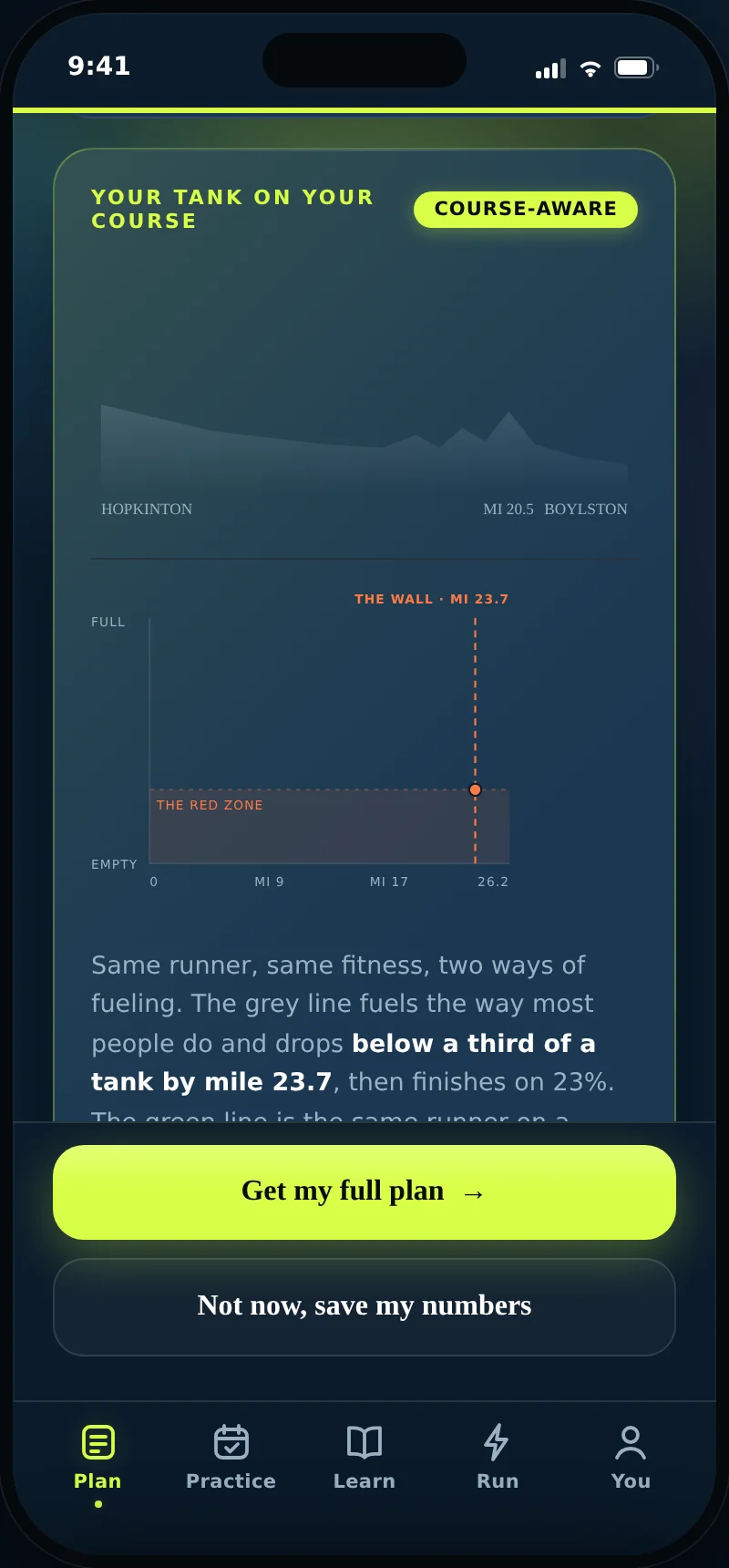
CarbRate places your gels where the water actually is
A gel without water sits, even the right gel at the right time.
Your race publishes where its water stations are. CarbRate places your feeds on them, and weighs a real station more heavily than anything else in the placement.
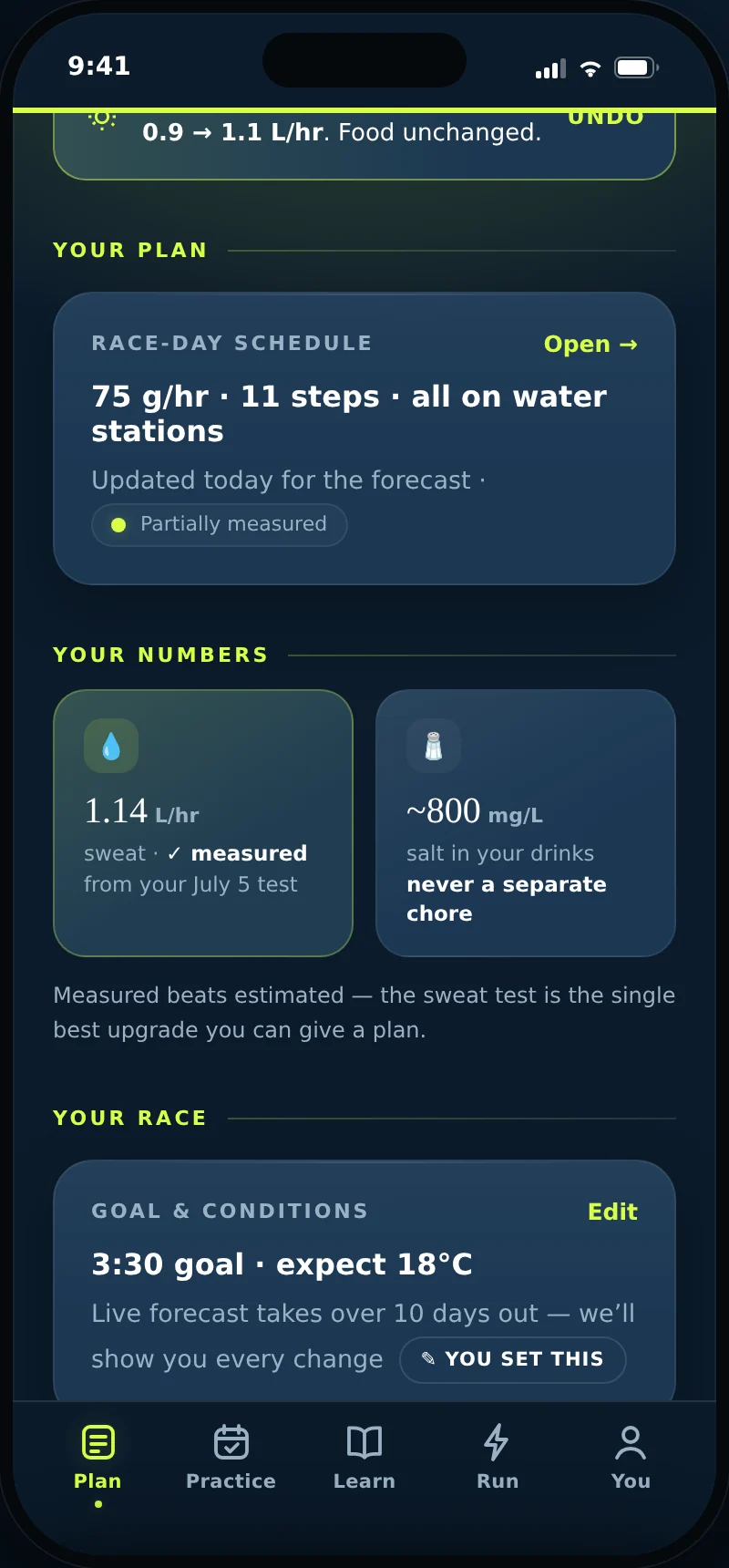
In our worked Boston example, a 3:30 goal at 18°C, all eleven feeds land on a real aid station, none of them on a climb above 3%, and no feed moves more than six minutes from when it was due.
And where a stretch of your course has no station, CarbRate says so instead of pretending. The feed is marked carry your own water.
You find that out in your kitchen, weeks before, rather than at an empty table at mile 18.
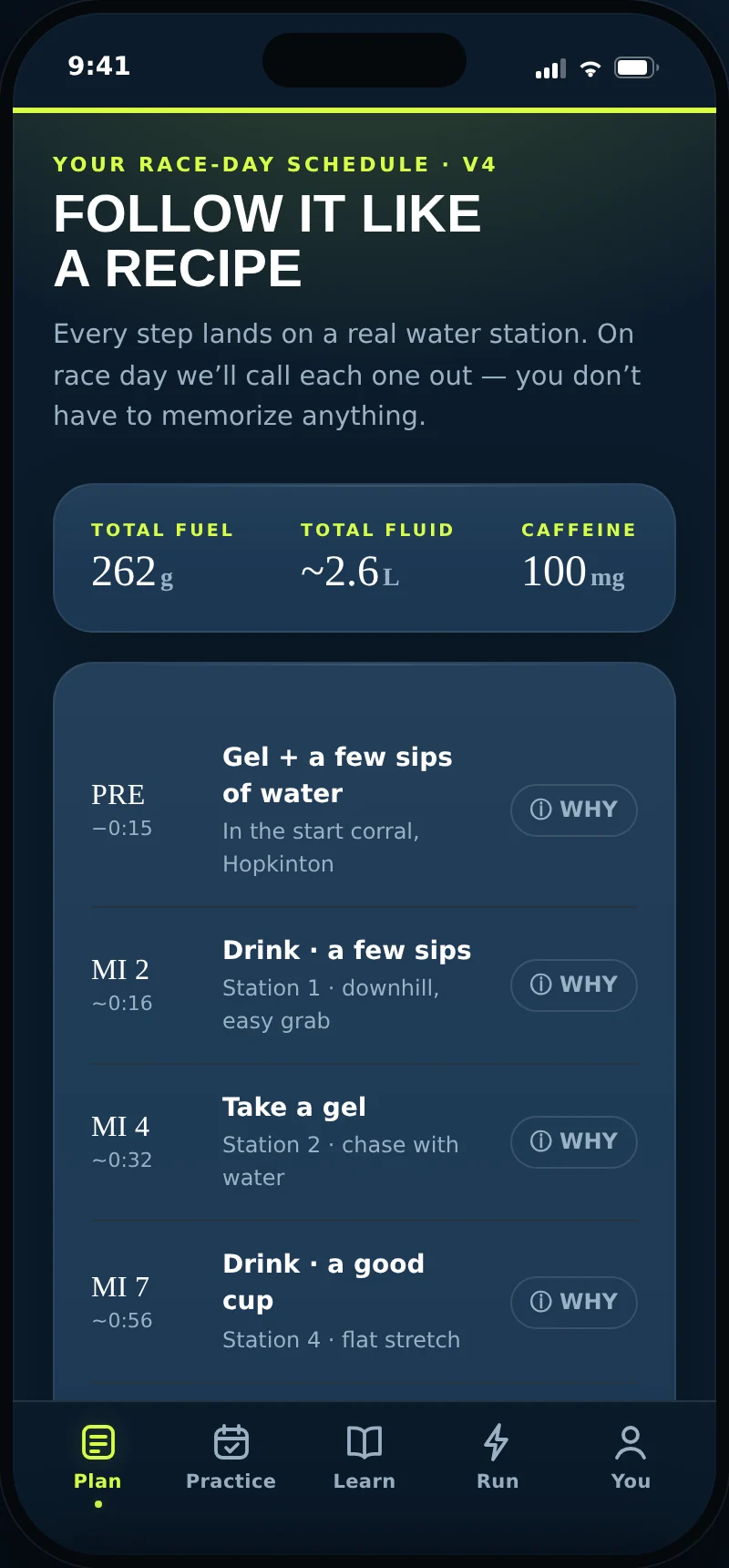
CarbRate tells you exactly how much it knows about your course
Not every race publishes its elevation and its aid stations, and plenty of runners are training for a race that is not on anybody's list.
Most apps quietly plan the same way either way. You never find out which parts of your plan were real.
CarbRate labels it instead, in three honest tiers.
When it has your course and the stations, every feed lands on a real one.
When it has your course but not the stations, your feeds still dodge the climbs, and you are told to carry your own fluid.
And when it has neither, your plan is timed to your goal pace, and you can attach the course later. Every feed then snaps onto it.
You always know which part of your plan is measured and which part is an estimate.

CarbRate turns your course into a schedule you can follow like a recipe
The output is not a chart to interpret. It is a list.
Mile marker, what to take, which station it is on, and one line on why it is there.
You can print it as a cheat sheet, and on race day CarbRate calls each step out loud so you never have to read it.
Nothing about your race-day fueling is left to be worked out while you are running.
Not a major marathon? Know the course already?
One plan that knows the road you are actually running
You have studied the course map. You know where the hills are and roughly where the water is.
Your fueling plan is the last part of race day that still thinks you are running a flat, featureless 26.2 miles.
- Fueling plan built on your exact course
- Personalized to your sweat rate, weight, and goal
- Adjusts when the race-day forecast moves
- Week-by-week gut-training practice schedule
- One prescribed change after every rough run
- The dress-rehearsal run, scheduled early
- Live guidance through every gel and drink
- All 163 gels, chews, and mixes built in
See how CarbRate handles the rest of your race
A page for each one: