CarbRate tells you exactly when to fuel during the race
Tired of doing arithmetic at mile 18 to work out whether you are behind on your gels?
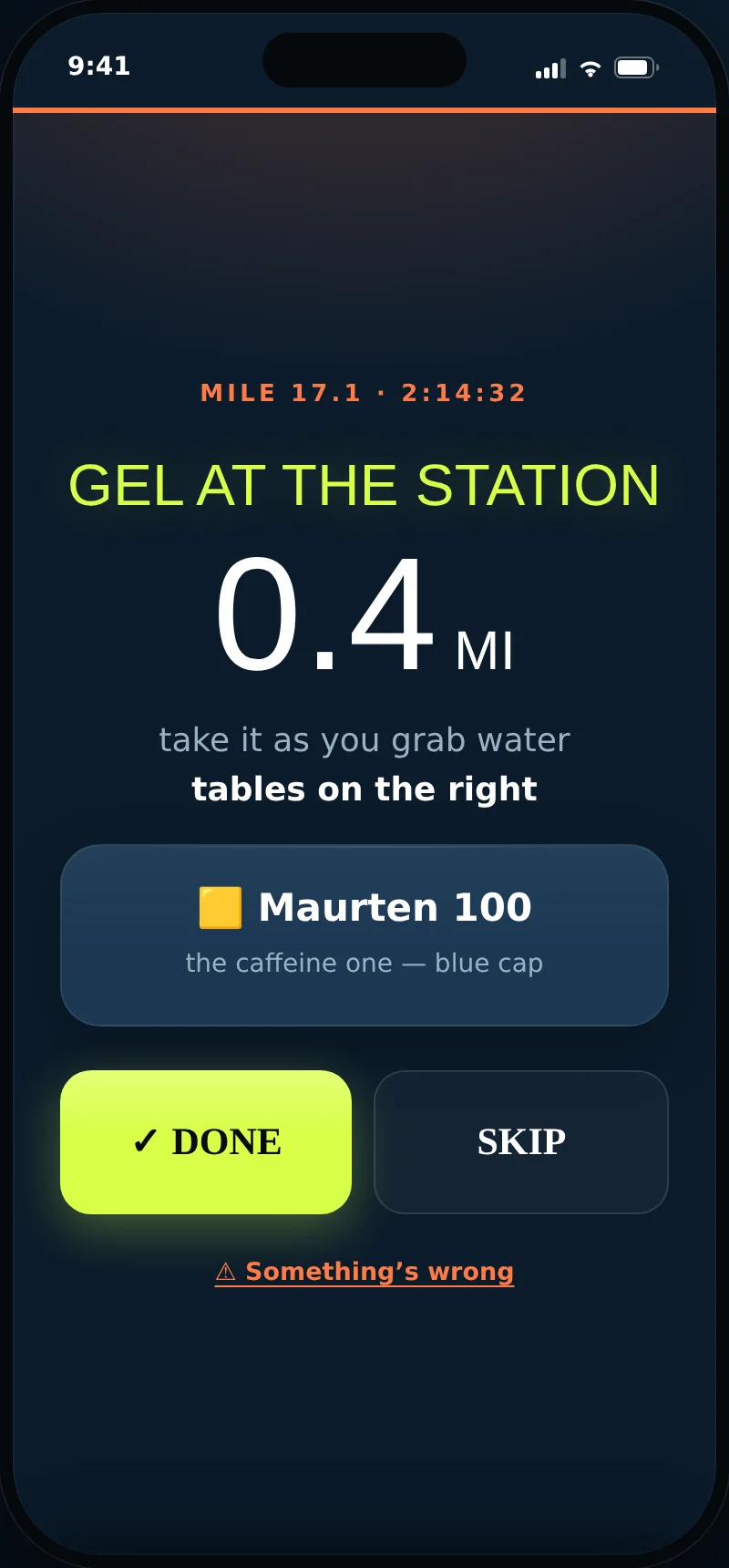
On race day CarbRate counts down to every feed, tells you exactly what to take and where, and says it out loud over your music.
Nothing to memorize, nothing to check, and no math while you are running.
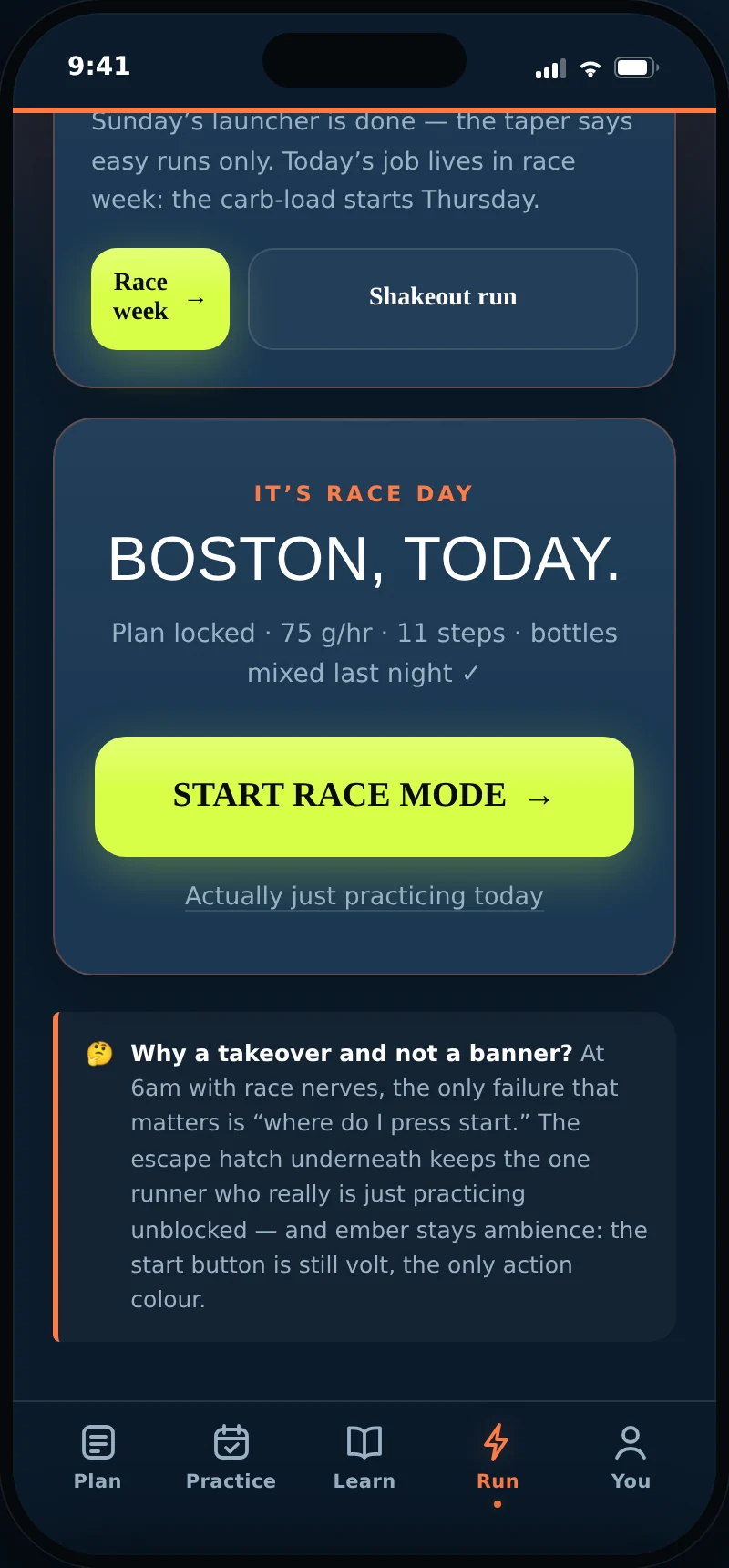
Why the plan you memorized falls apart in the last hour, even though you knew it cold on the start line
You know your plan perfectly at 7am. Gel at 4, drink at 7, the caffeine one before the hills.
By mile 18 you are at threshold, your watch is showing four things at once, and you are trying to remember whether the last gel went down at 1:34 or 1:44.
Decisions get hardest exactly where they matter most.
A missed feed does not announce itself either. You feel fine for twenty minutes, and then you do not.
Then there is the aid station itself. You get about 8 seconds to decide whether this is the one you were supposed to take, while people cut across in front of you.
None of that is a discipline problem. It is what happens when you ask a runner at race effort to also be the timekeeper.
Luckily, your plan already knows every one of those answers. It just has to speak up.
A written schedule is worth about eleven minutes
, runners given a structured fueling schedule finished in 3:38:31 against 3:49:26 for runners matched to them on fitness who fueled as they saw fit.
That is 10 minutes 55 seconds, or 4.7%, from the fueling alone.
The scheduled group took in 64.7 grams of carbohydrate an hour. The free-choice group took 38.0 and did not know they were short.
That gap is not carelessness, and it is not rare.
at real events, marathoners averaged 35 grams of carbohydrate an hour, roughly half of what a three to four hour race calls for.
And when , marathoners who planned 25.9 grams an hour actually took in 21.7. They ate less than they meant to and believed they had eaten more.
Knowing the plan and executing the plan are two completely different skills, and the second one falls apart under race effort.
That is why CarbRate runs the schedule for you while you race.
CarbRate tells you exactly what to carry before you leave the house
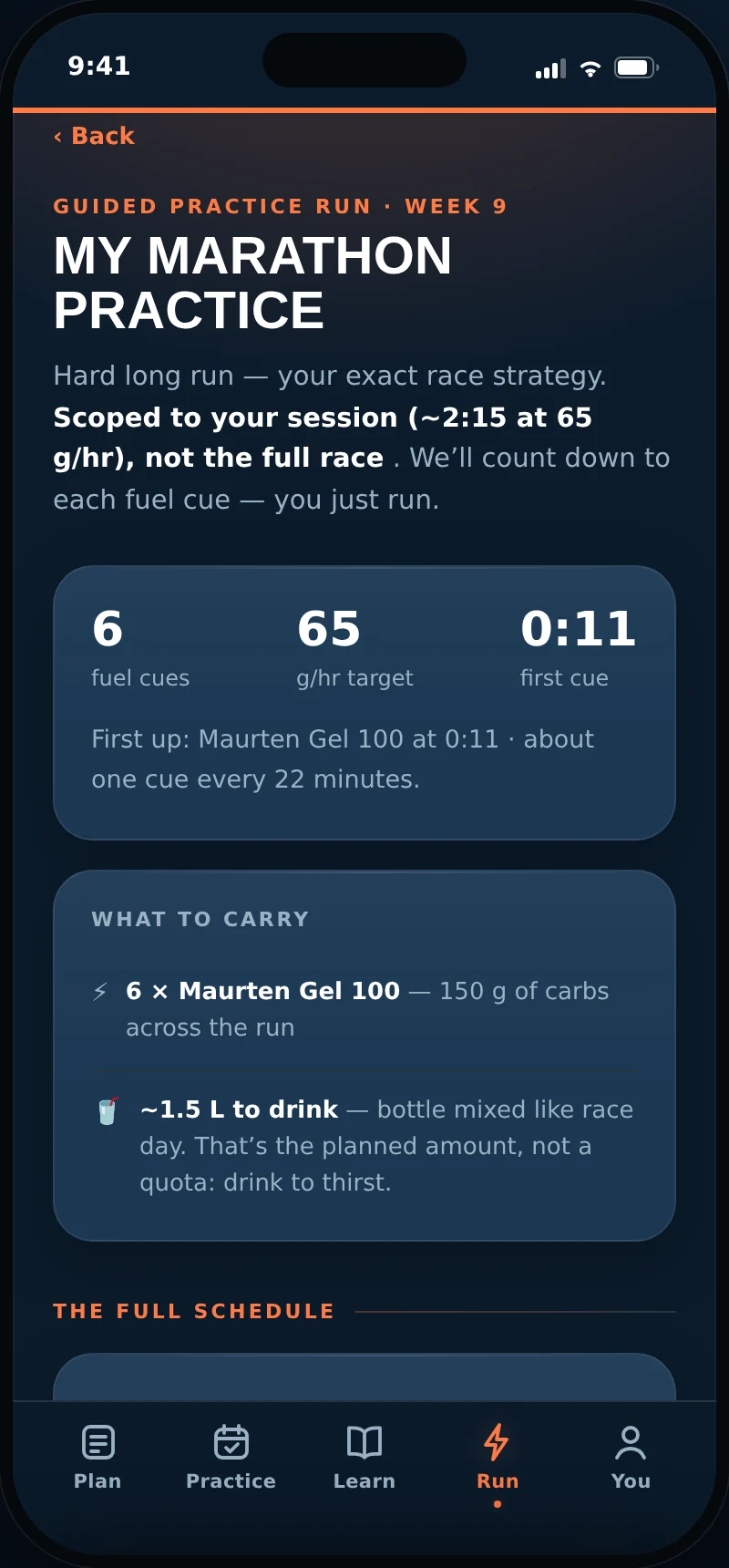
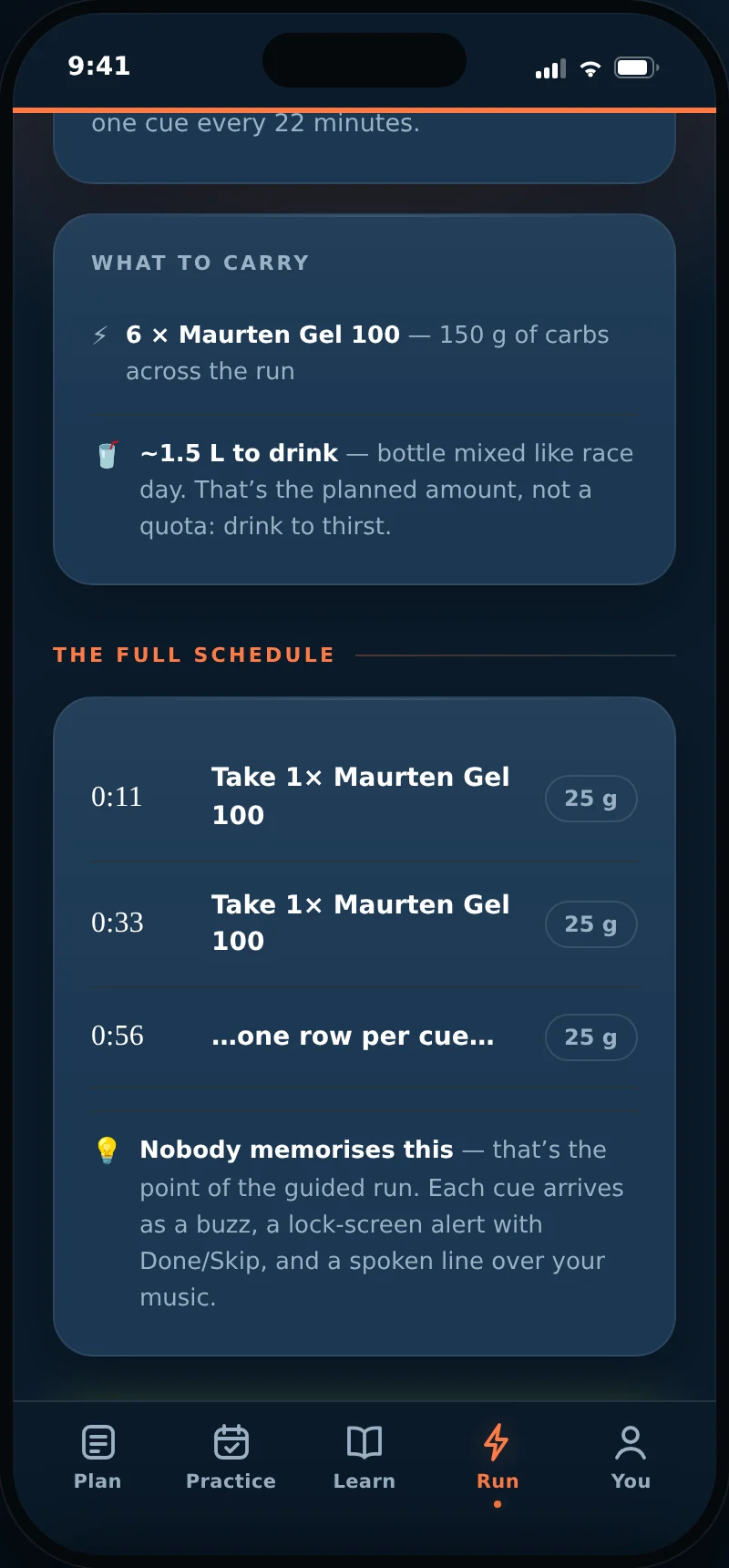
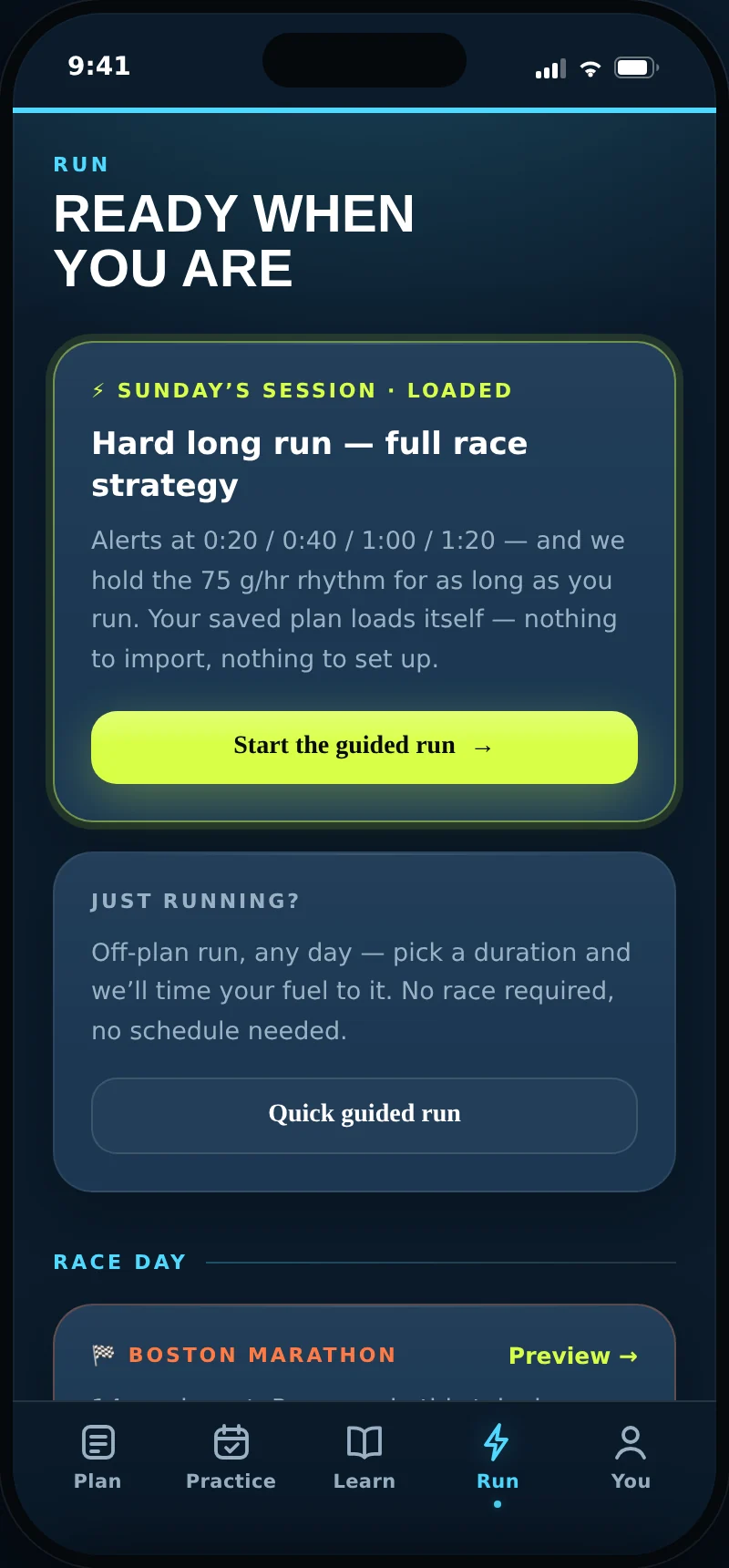
The guided run is set up before you start it, not during.
How many cues you will get, what rate they hold you to, when the first one lands, and the exact carry list: how many of your gel, and how much to mix in the bottle.
The list is counted in your actual products, so it says six of your gel rather than 150 grams of carbohydrate.
Then the full schedule underneath, cue by cue, so you can read it once and forget it.
Nobody memorises that list. That is the entire point of the guided run.
CarbRate calls each feed out loud so your phone stays in your pocket
About 45 seconds before a feed is due, CarbRate tells you. Take one of your gel, next fuel in 22 minutes.
The line is spoken on your phone and it ducks your music rather than stopping it.
At the same time a lock-screen alert arrives with Done and Skip on it, and both work straight from the lock screen.
CarbRate uses elapsed time rather than tracking you by GPS, and every cue is generated on your phone.
And when something goes wrong there is one button for it. A stomach that has turned, a bathroom stop, a dropped bottle: each one gives you ordered steps and, just as usefully, what not to do.
CarbRate guides your long runs the same way it guides your race
Race day is a bad day to use something for the first time.
So the same guidance runs on your practice sessions, at the week's carb target, stretched over the distance you are running.
Your saved plan loads itself. There is nothing to import and nothing to set up.
By race morning the voice in your ear, the products in your belt and the rhythm between feeds are all things you have already done a dozen times.
CarbRate turns race day into the data for your next one
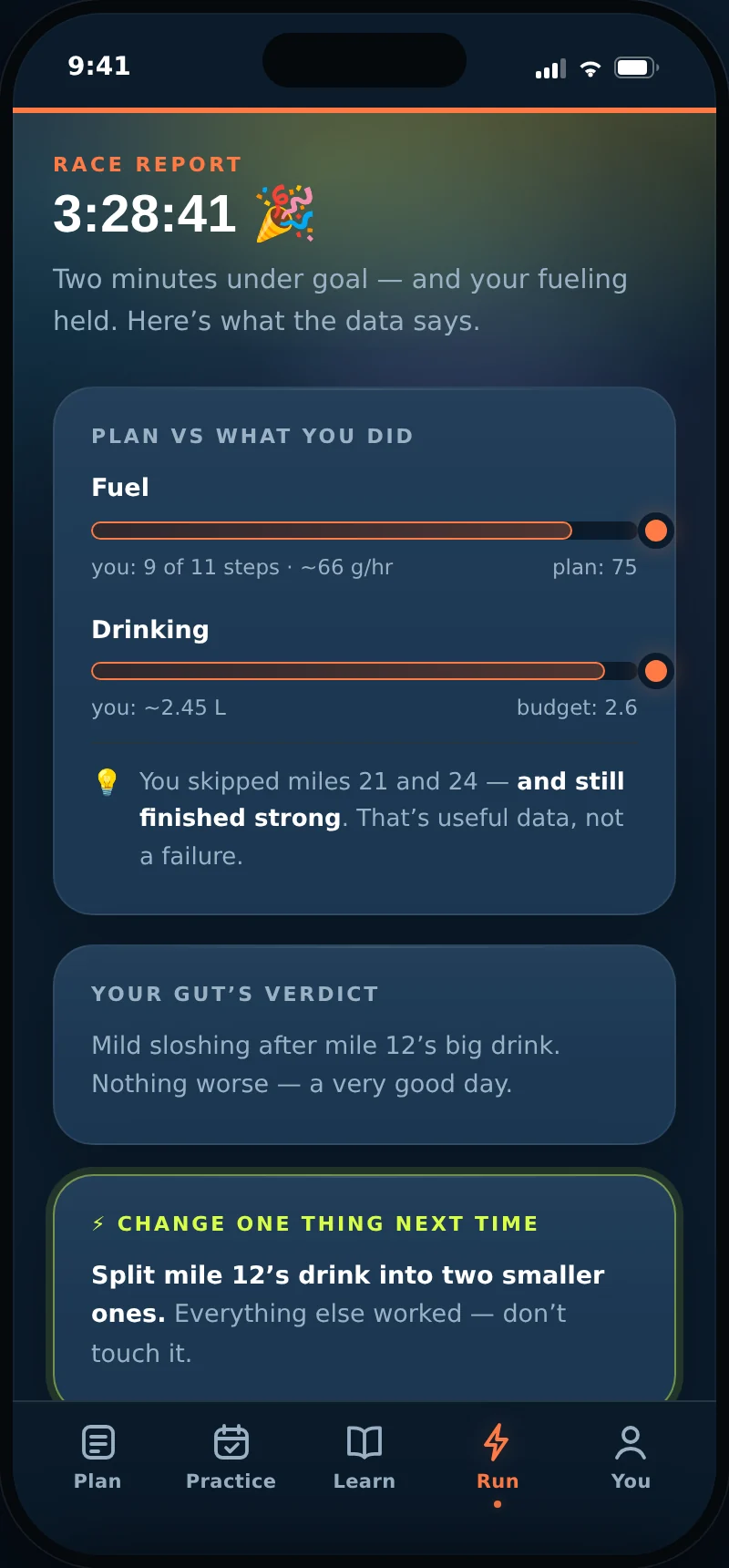
20 seconds after you finish, CarbRate asks two things: which feeds you actually hit, and how your stomach handled it.
It already knows what you hit during the run, so most of that is pre-filled.
What comes back is your adherence, an estimated rate you actually held, and one line on what to change next time.
You skipped miles 21 and 24 and still finished strong. That is useful data rather than a failure.
And it is a card you can keep, so the next build starts from what happened rather than what you remember.
Phone in your pocket? No signal?
A plan only counts if you actually execute it
A fueling plan is a set of decisions you made in advance, calm and rested, with all the information in front of you.
Live guidance is what makes sure the runner at mile 20 carries them out.
- Fueling plan built on your exact course
- Personalized to your sweat rate, weight, and goal
- Adjusts when the race-day forecast moves
- Week-by-week gut-training practice schedule
- One prescribed change after every rough run
- The dress-rehearsal run, scheduled early
- Live guidance through every gel and drink
- All 163 gels, chews, and mixes built in
See how CarbRate handles the rest of your race
A page for each one: