A carb load built from your weight and goal time
Tired of carb-loading advice that says to make 75% of your plate carbohydrate, with no way to know whether that is enough for you?
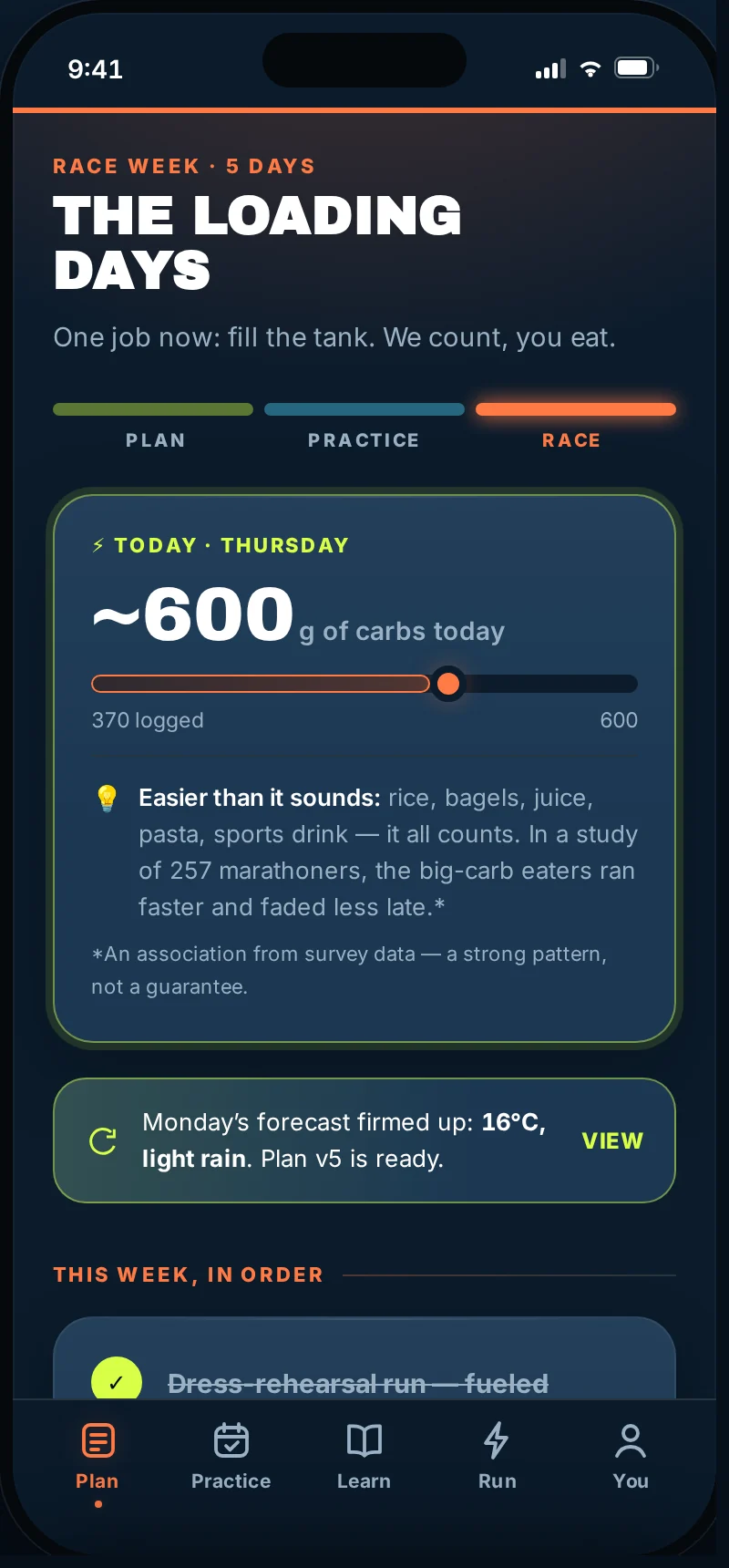
CarbRate reads your weight and your goal time off the plan you already built and prescribes the grams of carbohydrate to eat on each day before your race, plus the grams to eat on race morning.
Then it puts those days on a race-week checklist against your race date, so you know what Thursday looks like without recalculating anything.
Why you can carb load for 3 days and still start the race with a normal tank
Almost every carb-loading guide is written as a share of your plate. Eat 70 to 75% of your calories as carbohydrate, or fill most of your plate with pasta and rice.
A share of a small appetite is a small number of grams. A 125 lb (57 kg) runner and a 176 lb (80 kg) runner following the same advice end up with different grams on the plate.
Your muscles start storing extra glycogen at about 8 g of carbohydrate per kilogram of body weight per day (3.6 g per lb). The 75% rule gives that 57 kg runner 448 g a day, which is 7.9 g/kg (3.6 g/lb).
That means she can follow the instructions for 3 days and never carb load at all.
The old advice also tells you to keep your calories the same and swap fat for carbohydrate. In , women who raised carbohydrate as a share of their calories did not raise their muscle glycogen at all. When their total calories rose by 34%, muscle glycogen rose by about 17%.
Then race morning gets left out of the guide entirely, and you improvise breakfast.
Luckily, the amount you need is a simple number: grams per kilogram of body weight, for a set number of days, plus one dose on race morning. CarbRate works it out from the weight and goal time in your plan.
Your finish time decides whether to load. Your weight decides how much.
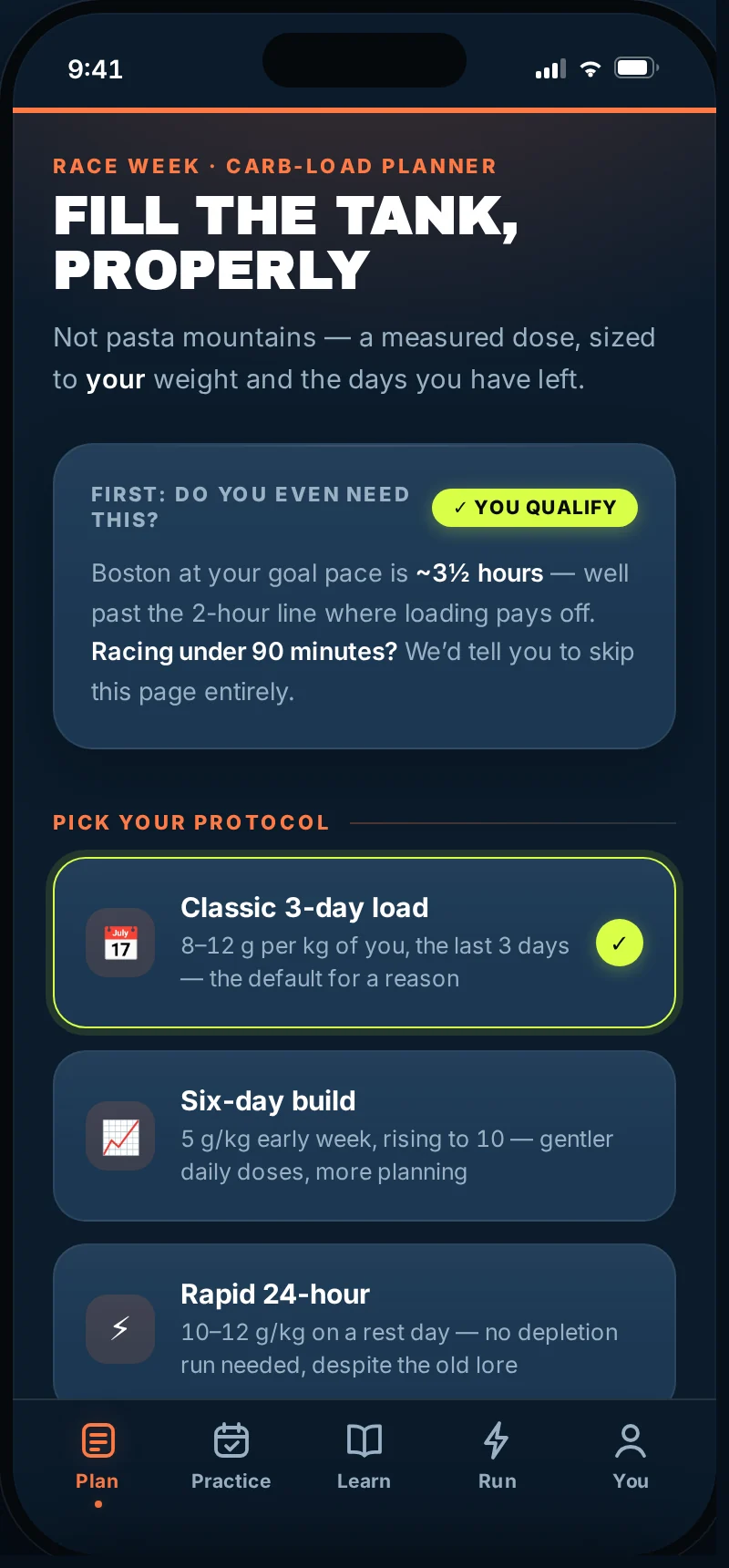
You store enough glycogen to cover about 90 minutes of running. If your race is shorter than that, you finish with glycogen still in your legs, and loading changes nothing.
Between 90 minutes and 2 hours, one day at 6 to 8 g of carbohydrate per kilogram of body weight (2.7 to 3.6 g per lb) is enough.
Past 2 hours, a full load of 8 to 12 g/kg per day (3.6 to 5.5 g/lb) is worth doing. In , cyclists who loaded started a 3-hour ride with 47% more muscle glycogen and held more power over the final 60 minutes.
CarbRate checks your projected finish first and tells you which of the 3 cases you are in.
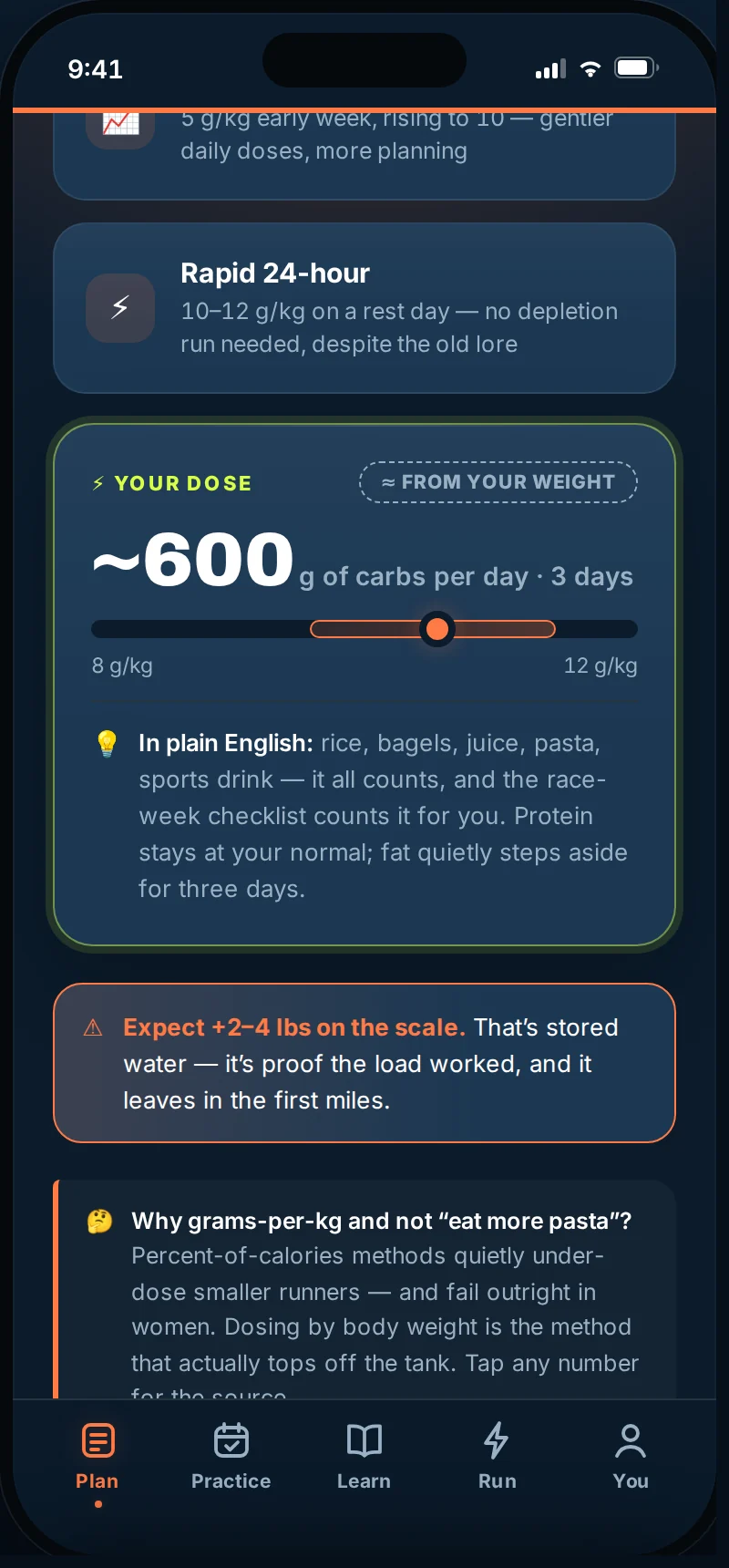
Then it takes your weight from your plan, applies the dose for the taper you are running, and gives you your grams of carbohydrate per day, your protein needs per day (1.5 g/kg, 0.7 g/lb) and the extra calories you need to eat.
To do that yourself, you would need your weight in kilograms, the dose for your taper, the number of days, and a calendar.
That is why CarbRate does the arithmetic and puts each day on your race-week checklist.
Does your race need a carb load?
Type a time to see which of the 3 cases you are in.
CarbRate tells you whether you need to carb load at all
Your projected finish decides it. Under 90 minutes, your normal glycogen stores cover the race.
Between 90 minutes and 2 hours, one day at 6 to 8 g/kg (2.7 to 3.6 g/lb) is enough.
CarbRate checks your finish time before it prescribes anything, and tells a half marathoner running 1:45 to skip the 3-day load.
So you never eat 3 days of extra food for a race that does not need it.
CarbRate prescribes your grams of carbohydrate for each loading day
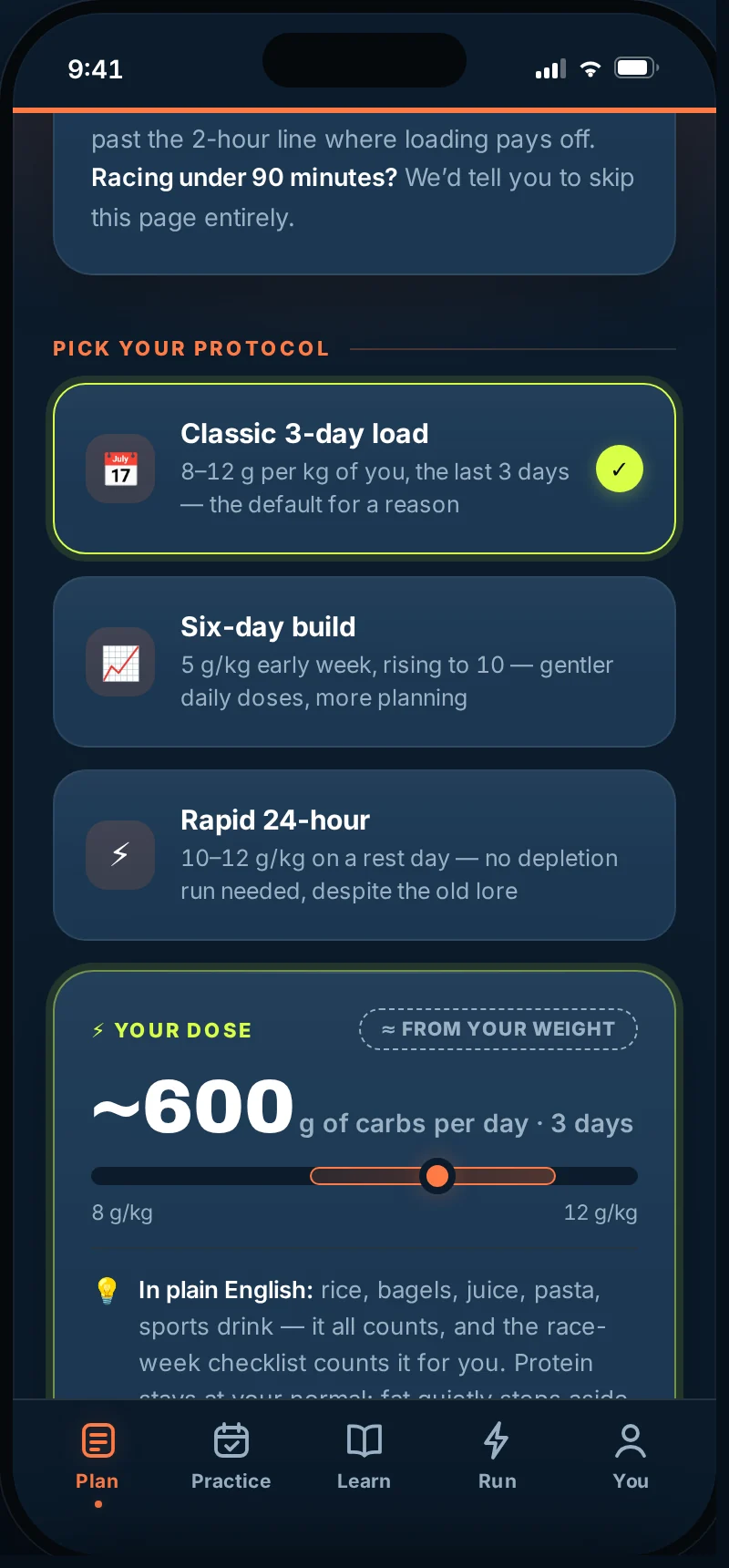
The dose depends on your taper. A classic 3-week taper takes 8 to 10 g/kg (3.6 to 4.5 g/lb) over the final 3 days, or 10 to 12 g/kg (4.5 to 5.5 g/lb) over the final 2 days if you are well trained.
A short taper holds 10 g/kg (4.5 g/lb) for 3 days. No taper at all takes 10 to 12 g/kg (4.5 to 5.5 g/lb) on the one rest day before the race.
You pick the taper. CarbRate picks the protocol and the days.
For a 150 lb (68 kg) runner on the classic taper, that is 545 to 680 g of carbohydrate a day.
Protein stays at 1.5 g/kg (0.7 g/lb) and fat comes down, and CarbRate shows you the extra calories, because a load that adds no calories is the one .
CarbRate tells you how much to eat at breakfast
Your muscles keep their glycogen overnight, but your liver uses some of its glycogen while you sleep. Breakfast refills it.
You need 1 g of carbohydrate per kilogram of body weight (0.45 g per lb) for every hour between your meal and the start.
CarbRate takes the hours you set and gives you the grams: about 205 g for a 150 lb (68 kg) runner eating 3 hours before the gun.
A bagel with jam, a banana, a large glass of juice and a sports drink gets you close. Nothing on that plate should be new.
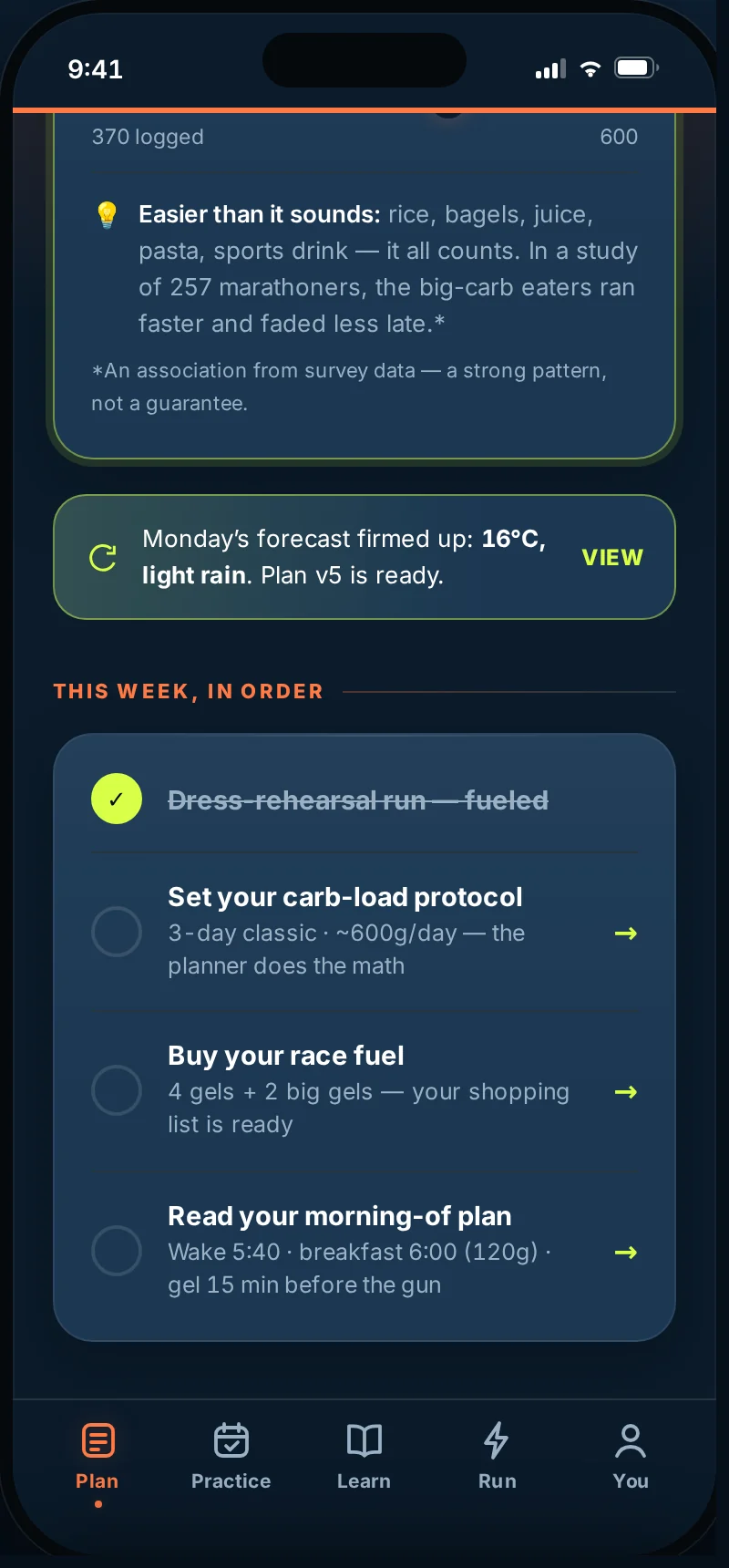
CarbRate puts every loading day on a dated race-week checklist
The planner reads your race date and writes each loading day against it, with the day's carbohydrate target next to the date.
Turn on reminders and CarbRate sends you the day's target each morning.
You know what Thursday looks like without recalculating anything, and the scale going up 2 to 4 lb tells you the load worked.
Half marathon? Low-carb? Worried about the scale?
A carb load with the right number of grams
You already know the pasta dinner is not the whole story, and that the load starts days out.
Your grams per day should come from your weight and your race, in the same app as your fueling plan.
- Fueling plan built on your exact course
- Personalized to your sweat rate, weight, and goal
- Adjusts when the race-day forecast changes
- Week-by-week gut-training practice schedule
- One prescribed change after every rough run
- The dress-rehearsal run, scheduled early
- Live guidance through every gel and drink
- All 163 gels, chews, and mixes built in
 Julie Beaudoin
“This app helped me test products throughout my training for Grandmas and put together a plan with more drinking. It was the first time I’ve finished with no stomach issues.”







See how CarbRate handles the rest of your race
A page for each one: